The 'Rochester Canvas'
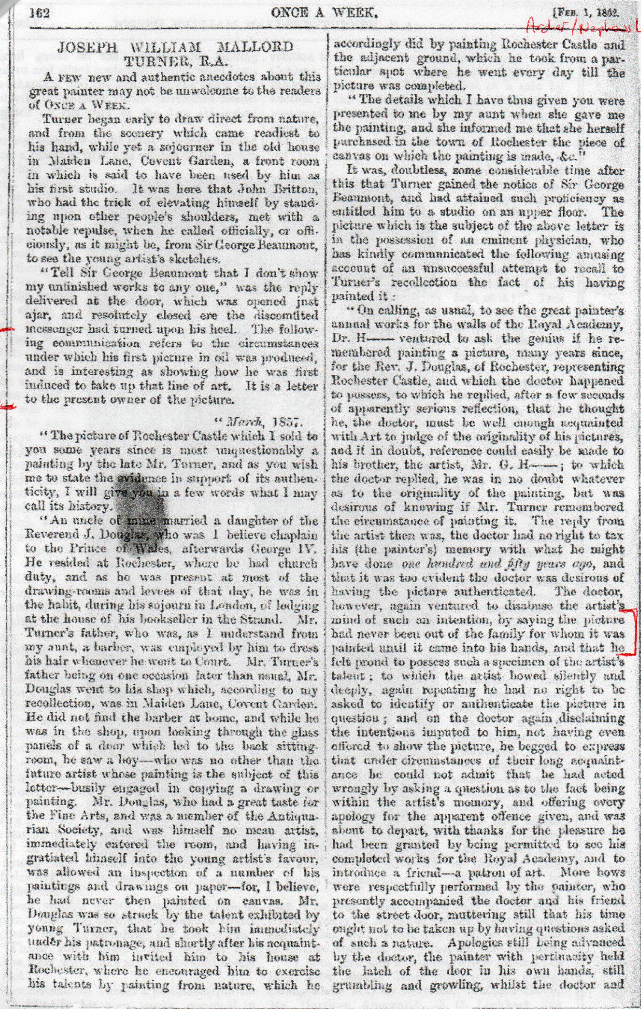
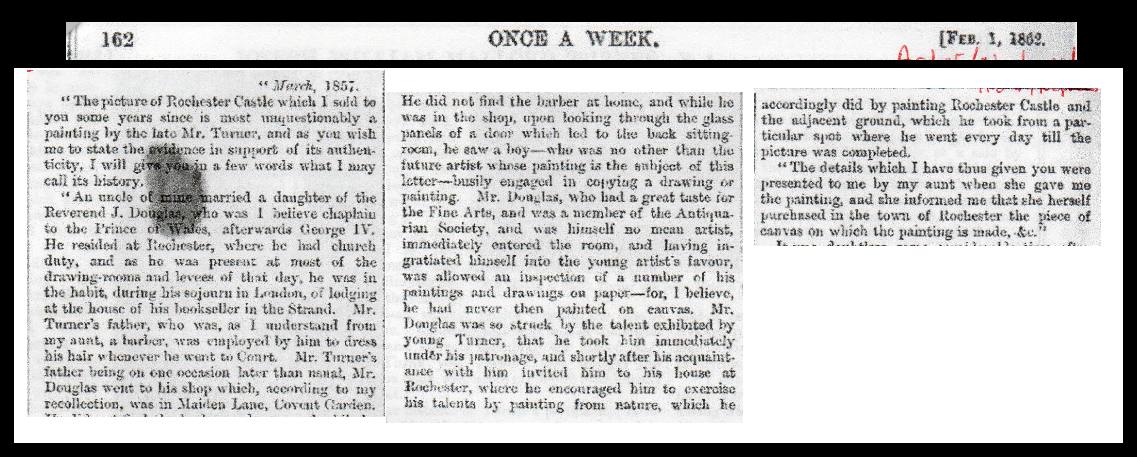
Evidence for the 'Rochester Canvas' is twofold. First, the so called 'Nephew's Letter' which tells of the purchase and second the identification of four oils on canvas painted within a very short time around September 1792 which suggests that the purchase provided sufficient canvas for four paintings. This page considers various scenarios as to exactly what is the Rochester Canvas.
see also Two Rochester Pictures
Nephew's Letter
A brief overview is given in Nephew's Letter and Rochester Canvas and points arising are:
The letter was written in 1857 some 65 years after the canvas was purchased. We do not know when the picture was given to the nephew but in the full article Archer reports a meeting between Dr. Hering and Turner at which the picture was discussed. This cannot be much later than 1845. The gift must have taken place after 1811 when Margaret Martha married Mortimer Tucker (the uncle). This roughly suggests that the gift of the painting to the nephew was made some time during the 1830's and that the nephew is reporting his aunt's comments which he recalls from about 25 years previously. Since he is recalling his aunt's perception of what she (or she and Turner) bought we consider what she might have conveyed to him. Using the phrase 'piece of canvas' conveys the thought that the canvas was, at the time of purchase, part of something bigger. A 'piece' is something removed from something else. A manufactured artist's canvas on its stretcher is a single entity; not a 'piece' of canvas. If Turner's 'piece' of canvas was removed from something bigger it is almost certainly bought off a roll of material. The natural, most obvious way to buy 'a piece' of canvas is by the yard from a roll. However, this was Rochester, a maritime environment, and it is not inconceivable that this was a purchase of a random piece of sailcloth.
Four Oils
Following the purchase, four oils were painted in quick succession. The dates of this tour are ascertained from Finberg and of two possibilities the probable tour during which the Rochester Canvas was purchased was September 1792. There are two suggestions that Turner went as far as Canterbury on this tour; first Finberg comments that Turner 'probably' went to Canterbury and second, two watercolour drawings of Canterbury emerged at this time, one of which was exhibited at the Royal Academy in 1793. It should be noted that a second tour of Kent took place in August 1793 and it was on this second tour (said to be one of six weeks) that Turner was accompanied by Edward Bell.
The purchase must have been made during the return journey of the tour because the Nephew's letter shows clearly that the first oil was completed at Rochester. That first oil remained with the Douglas family and at least two auctions of it are recorded. A second oil was recorded by Miller (thinking that it was the first!) "painted...by Turner, done duringt this journey, and finished...at Foot's Cray".
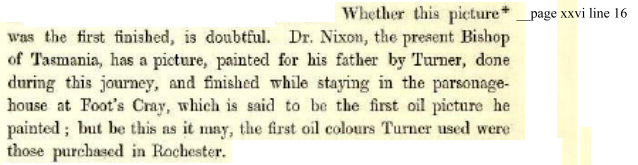
So Turner went from London to Canterbury. Then returned via Rochester and Foot's Cray in that order.
MAP to be inserted
The Width of the Canvas
In a compilation by Barbara A Buckley__Stretchers and Strainers_Materials and Equipment - Wiki. saved here as a .pdf file (the original and any updates can be accessed on Google) from pdf page 22 we have:
Most sources place the industrial revolution around 1760-1820. In 1792 it is therefore likely that the wider loom would be in use. 1 meter 40 cm is about one and a half yards or 54". A yard of this material would yield four pieces 27" x 18". Attached to stretchers these pieces would present a smaller painting surface.
Before September 1792 Turner was painting exclusively in watercolour on paper. His 1792 RA Exhibits 436, Malmsbury Abbey and 472, The Pantheon, The Morning After The Fire were 21" x 15" and 15" x 20" respectively. He would have been comfortable working on the canvas size indicated.
Stretchers
None of the references so far found mention stretchers. The paintings could have been painted on unstretched canvas in the manner of watercolours. However, Rev. James Douglas who seems to have been in overall charge of this exercise was an acomplished author, engineer, historian and portrait painter in oil and watercolour. We are searching for some of his work in oil to see what stretchers he used. Rev. Douglas apparently gave Turner paints ("purchased at Rochester") and is at least complicit in the purchase of the Rochester canvas and these two actions alone appear incongruous with allowing Turner to execute is first oils on unstretched canvas.
If Rev. James Douglas supplied stretchers we need to consider where he obtained them and, in particular, whether he had made them himself. The first question should perhaps be 'why did he make stretchers?'. He was not a rich man but he was not so poor that there would be a financial incentive. His background implies scientific experimentation and at the time of his painting days around 1770 to the mid 1780s there probably were already attempts to produce adjustable stretchers and he may well have been doing this. The only very tenuous evidence we have for this is the stretcher on 'Squall at St Vincent's Rock, Bristol'. This stretcher has characteristics of 'homemade' rather than 'manufactured for sale'; the members are not all made from the same wood; its peculiar joints and stretching mechanism have not been found elsewhere; one of the joints (illustrated on the link) is not cut straight; it has no maker's mark. The second question is 'When did he make them?' and to answer that we need to find some of his oils. However, they were probably not made in Rochester, he seems to have moved on from painting around the time of his marriage in 1780. Whatever the reasons it does appear that Rev. James Douglas supplied the stretcher(s) from existing supplies.
Taking information from the Nephew's letter and from Miller two of the oils were painted during the tour and remained with their respective patrons. That would result in the other two being completed in London.