
JMW Turner's Two 'St Vincent's Rock' Exhibits of 1793
Chapter I: The rising squall, hot wells, from St. Vincent's rock, Bristol: Evidence that it is a canvas
JMW Turner's Two 'St Vincent's Rock' Exhibits of 1793
Chapter I: The rising squall, hot wells, from St.
Vincent's rock, Bristol: Evidence that it is a canvas
'The rising squall, hot wells, from St. Vincent's
rock, Bristol'
by JMW Turner; exhibited at the Royal Academy in 1793
Evidence that it is a canvas
1. Circumstantial evidence that it is a canvas by establishing a sequence of events
Evidence that 'The rising squall, hot wells, from St. Vincent's rock, Bristol' is a canvas is circumstantial. By establishing a sequence of events for 1791 to 1793 we find that in 1792 JMW Turner painted three oils, probably small at around 15"x 20", in a short period of time. Canvas for the first two must have been cut from a larger piece purchased in Rochester and, cicumstantially, the third canvas was likely to be from the same (Rochester) canvas. That left one piece of canvas remaining for the next recorded oil which was the 1793 RA exhibit.
Circumstantial evidence here is a very small extension to recorded reality. It fits absolutely with recorded events and is the most logical explanation as to why after painting the first four oils on canvas JMW Turner followed by using paper, panel and veneer substrates for his oils for a short period of time after the 1793 exhibition.
2. Events Related To JMW Turner 1791 to 1793
3. Placing the Other Events (B) Into the Sequence of Events (A)
A and B above in Chronological Order
JMW Turner, accompanied by Margaret Martha Douglas, daughter of Rev. James Douglas, purchased canvas in Rochester during the return journey of the first of the two Kent tours examined here. Two oils were painted on that canvas during the journey and a third, 'Self Portrait age 16', was painted in London. The size of 'Self Portrait age 16' (20½"x 16½" - now in the Indianapolis Museum) and the size of Rev. Nixon's commission, 'The Country Waggon, Snowdon - Early Morning (25" x 30"); make it difficult to reconcile the overall size of canvas and a pattern of division; the standard width at that time appears to be 54". A possible explanation may lie in the stretcher sizes available to Turner but we do not have any evidence of this. The size of the first oil, the Douglas commission, is unknown.
4. Fourth piece of Rochester Canvas Used for 'The Rising Squall'
The self portrait is known to be on canvas and painted at around the same time as 'The Rising Squall' and it seems therefore that a fourth piece of canvas remaining was available for JMW Turner's oil exhibited in the 1793 exhibition. Other oils from this 1793 period after the first tour were painted on panel or paper.
Other Events (1791-1793) not related to the Canvas:
These notes relate to events recorded for the period but which are not discussed in detail here because they do not relate to identifying 'The rising squall, hot wells, from St. Vincent's rock, Bristol' as a canvas. They are included here as issues which may be further investigated later. (written: November 2020)
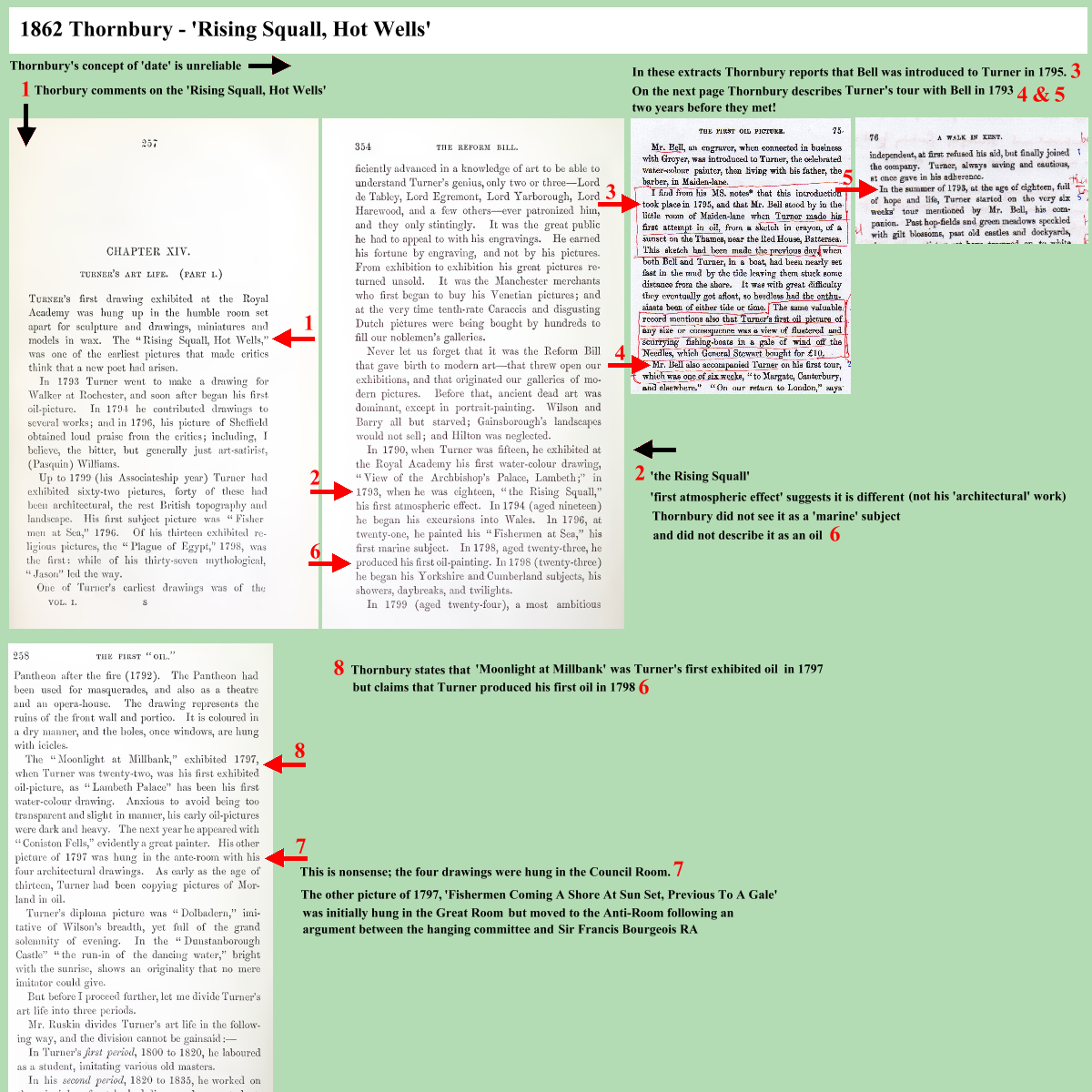
Turner's Introduction to Edward Bell. (after the 1793 exhibition, before
the Walker commission/six weeks tour)Thornbury,
banner
Thornbury 1862 vol I (pp
75-77) refers to this and a following six week tour to Kent on which Bell
accompanied JMW. Thornbury conflates the two Kent tours mentioned by
Miller and more recent analysts seem to do the same. Moyle provides an
elaborate but again conflated narrative but on the whole the modern
writers equate Bell's tour with JMW Turner to the second Kent tour, the
Walker commission (and the Anderdon evidence below
supports this). The second Kent tour was in the 'summer of 1793'
(Miller) and therefore after the 1793 Royal Academy exhibition. at which
JMW Turner had exhibited 'The Rising Squall' and it is quite possible that
he took this picture to Nixon during the second tour. (in which case
Edward Bell could not possibly have described the Bell 'Sunset' as JMW
Turner's 'first attempt in oil'
The Anderdon papers at the Royal Academy include an annotated 1793
catalogue said to be annotated by Edward Bell. The annotations suggest
that Bell did not know JMW Turner personally at the time of the 1793
exhibition.
However, there is a problem: Thornbury makes it appear that the
introduction took place in the barber's shop. The 1793 catalogue shows
that at the time when JMW Turner delivered his exhibits to the exhibition
he was living and working in Hand Court having moved out of 26, Maiden
Lane.
The 'Bell Sunset' (before the Walker commission)
Thornbury describes a 'first oil' and sketching trips on the
Thames just before and just after the second tour. 'Sunset' cannot be the
first oil but it could be a first 'oil on panel' and it could be part of
the Turner Bequest. Butlin and Joll suggest that it could be 'Moonlight'
but that is doubtful. Butlin and Joll 194 is an 'odd man out' amongst the
Small Thames Sketches and additionally was omitted from the 1856 schedule.
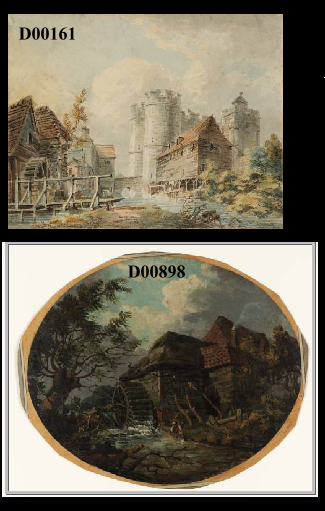
Painting of the 'Watermill' (after the Walker commission)
After the second tour. D00898
from D00161
An Alternative or Additional Identity for JMW Turner's Romantic
Attachment (Regarding his intended recipient of 'Self Portrait Age 16')
During the first Kent tour there is a definite suggestion that
JMW Turner and Margaret Martha Douglas purchased canvas in Rochester. This
is some time after the 1792 exhibition and therefore after May 1792. JMW
Turner was aged 17.
Rev. James Douglas (age 27) Married Margaret Oldershaw (age 20) in
1780. There are records of the birth of their sons but no record of the
birth of Margaret Martha. Therefore we cannot be sure of her age. It could
be that she was adopted or was James' daughter from a previous marriage.
That would make Oldershaw a 'stepmother'. It is said that it was a
stepmother who prevented JMW Turner's letters reaching her stepdaughter
and thus prevented Turner's marriage proposal.
Note that this is just something to follow up and there are other
recorded possible identities. We have not seen the evidence for Elizabeth
White in Margate who seems to be the 'favourite', or any others.