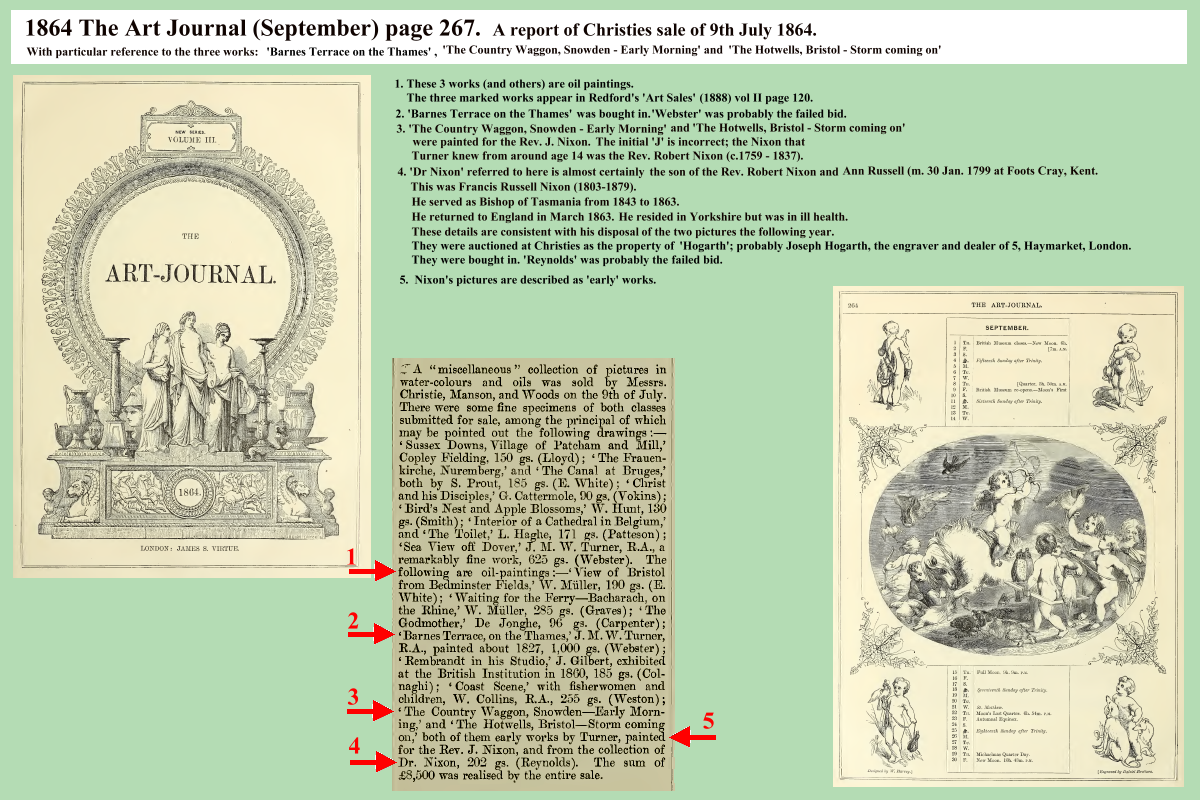
LITERARY EVIDENCE ~O~
The discovery of JMW Turner's oil on canvas exhibited at the Royal Academy
in 1793 ~O~
LITERARY EVIDENCE
1925 Purchase of the 'Bristol Watercolour'
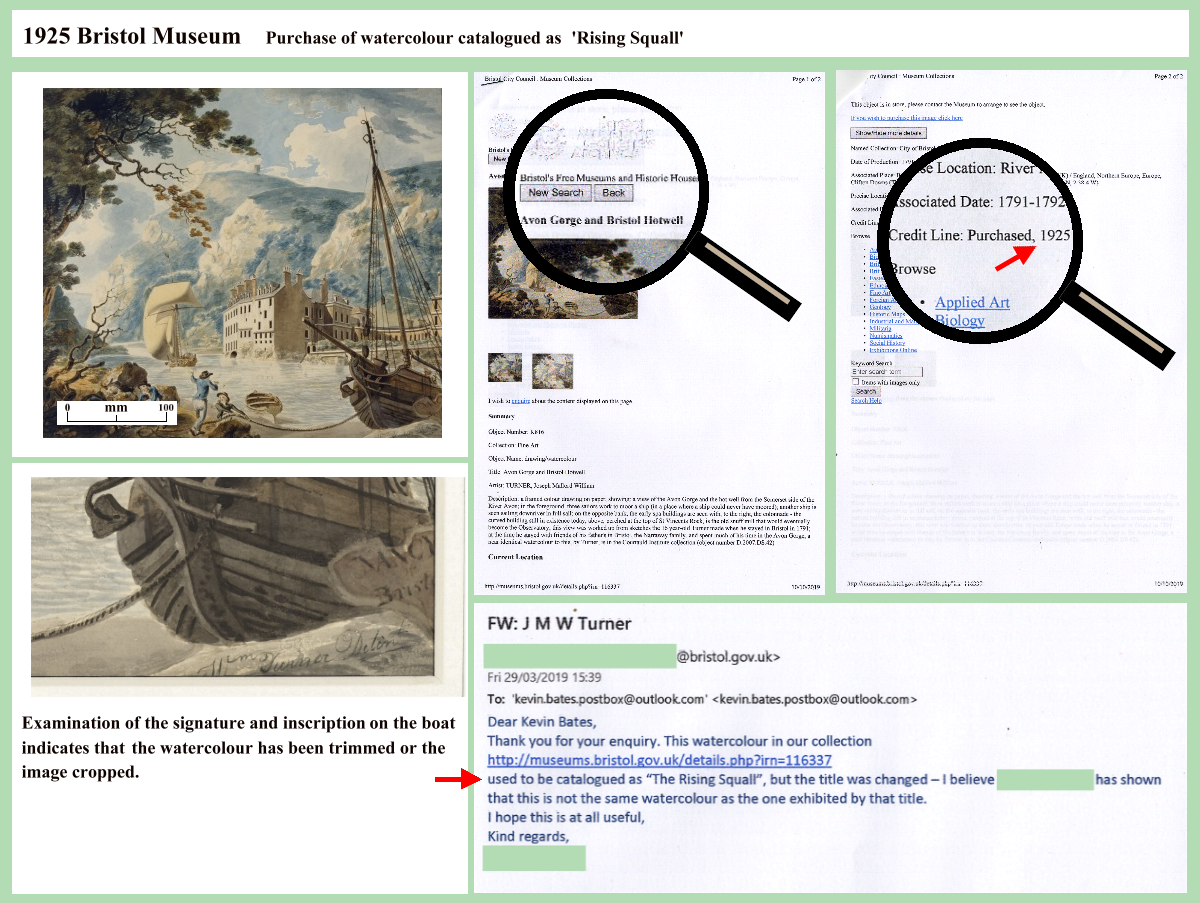
1925 Bristol Museum *[1] - The 'Bristol
Watercolour' was purchased in 1925 as 'Hotwell House' from Rev. J. Patton.
Analysis of the provenance *[2] suggests that Patton supplied the
provenance starting with 'Hull'. The watercolour was later misidentified
as 'The Rising Squall - Hot Wells [from] St. Vincent's Rock, Bristol' and
the concept of a 1793 oil, eliminated. In recent times it has been
acknowledged that the 'Bristol Watercolour' is not 'The Rising Squall -
Hot Wells from St. Vincent's Rock, Bristol' and its title has been
changed.
(The 'Bristol Watercolour' was probably the exhibit at No.323; but
it should have been called 'View of the River Avon, near St. Vincent's
Rock, Bristol' which on visual inspection of that watercolour it actually
is. The similar, but smaller, 'Courtauld Watercolour' has complete
provenance from 1791 when painted to the present;
[_COURTAULD_WATERCOLOUR_]
- After the 1925 purchase as 'Hotwell House' the 'Bristol
Watercolour' is believed to be 'The Rising Squall - Hot Wells [from] St.
Vincent's Rock, Bristol'.
- 'View of the River Avon, near St. Vincent's Rock, Bristol' is
presumably believed 'lost' (a lost watercolour)
- Consequently neither was included in Butlin and Joll and both
were recorded as watercolours when the Tate Turner Project was
undertaken.
[_NEXT_]
09_20
Footnote *[1]
Footnote *[2]
Patton appears to have sold the Bristol Watercolour as 'Hotwell House'.
There are a number of scenarios to consider:
- If Patton supplied the provenance in full: Notice that this
provenance refers to the 9th July 1864 sale in terms of Nixon and
Reynolds. It refers to the original owner as Rev 'J' Nixon, his
successor merely as Dr. Nixon and the 1864 buyer as 'Reynolds'. This is
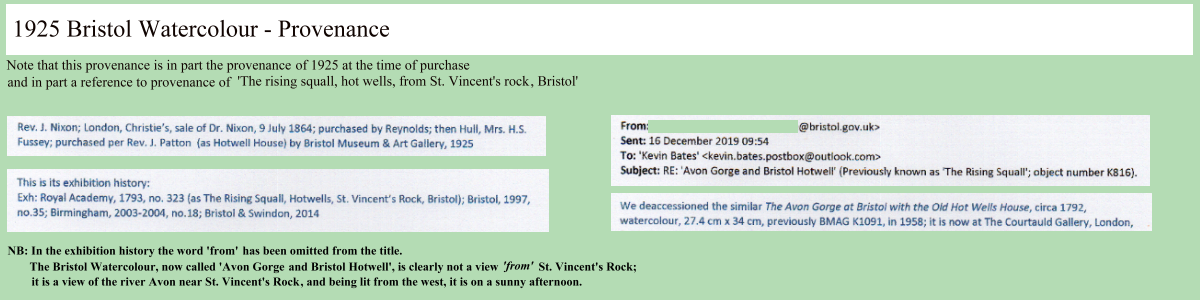
exactly the same as the September 1864 Art Journal information.*[3]But
The Art Journal states clearly that this is an oil - and that is not a
mistake; a Turner watercolour, 'Sea View off Dover', is specifically
mentioned in the same sale, it is clear that the writer was well
informed about this sale.
There was a 'John Nixon', an artist not a 'Rev.', in London at this
time and some references show him as the brother of Rev. Robert Nixon.
This, however, is not true (Massill).
The Rev. Nixon who supported Turner and introduced him to the
academy (via John F. Rigaud) was 'Rev. Robert Nixon of Foots Cray,
Kent'; 'Dr. Nixon' was Robert's (second) son, 'Rev. Dr. Francis Russell
Nixon, Bishop of Tasmania'. The appearance of the 'Nixon Turners' in
1864 coincides with the circumstances of Francis Russell at that time.
He returned to England from Tasmania in 1862 in ill health, took up an
appointment in York but was too unwell to fulfill the duties and retired
to Italy in 1865.
Looking closely at the Patton provenance, in this scenario, there
is nothing to suggest that Reynolds did not purchase a
watercolour from 'Dr Nixon' at that sale. It was the work of a later
curator who labelled this as 'The Rising Squall - Hot Wells [from] St.
Vincent's Rock, Bristol', the Art Journal name for the oil being 'The
Hotwells, Bristol, Storm coming on'. It is clear that there was at least
one other Turner watercolour at this sale, 'Sea View off Dover' bought
by Webster, so there could have been others; the Art Journal is quoting
only a few examples. (Generally speaking it appears that these sales
often resulted in additional transactions - after the event - of works
which were either not listed in the sale or were bought in: the
watercolour could have been bought by Reynolds in such circumstances.)
In terms of 'lifetimes' there are sufficient transactions to fill
the alloted timescale: 1864 to Reynolds (this could be F. D. Reynolds,
died c.1893, the Dublin dealer, and although there were no Turners in
his 1893 executor's sale the profile of the collection is suggestive of
a dealer who may have handled them.) so say Reynolds 2 years, Hull 20,
Fussey 20, Patton 20, that is 62 years after 1864 = 1926.
There are two points of fact: 1) Patton's watercolour was not the
'oil' of the Art Journal reference and 2) Patton's watercolour is not a
'Storm coming on' of the Art Journal reference; the Bistol Watercolour
is quite simply not a storm; a fine day with a good breeze but no storm
or squall.*[1]
Rev. Robert Nixon appears to have bought or commissioned a number
of works from Turner. There is no evidence to show that the Bristol
Watercolour was part of his collection - he (and Turner) would have
known it as 'View on the river Avon, near St. Vincent's rock, Bristol'.
The title from the earlier 1864, 27th April 1864 sale is 'St. Vincent's
Rock, Avon, Bristol Ex 1793', is a clear reference to the oil (not 'near'
but actually the rock itself).
- Another scenario is that Patton provided only part of the provenance:
Bristol Museum acknowledges that the Bristol Watercolour is not 'The
Rising Squall'. The provenance without 'The Rising Squall' element would
start at 'Hull' and the exhibition history would omit the reference to
the 'Royal Academy 1793'. This would initially put the Bristol
Watercolour amongst the many Turner Watercolours that were never
exhibited at the RA. However, this watercolour is so clearly 'a' 'View
on the river Avon, near St. Vincent's rock, Bristol' that, in the light
of an RA exhibition catalogue error of transposition of titles, it seems
likely that this was the exhibited work. (The other similar scene - the
Courtauld Watercolour - was not the exhibit; its provenance is complete
from the painting of it at the Narraway's to the present.)
The difficulty with this scenario is that the pre-Hull ownership is
unclear. If not the exhibited work and not owned by Nixon and not sold
on by Reynolds and, of course, not in the Turner Bequest, then where was
it? There must have been some record of Hull's ownership in order for
Patton to pass that information on.
- Exactly where Patton's provenance began is not determined. Either
Hull or Fussey could be later additions following the research by the
curator who analysed and renamed 'Hotwell House' (the 'Bristol
Watercolour') as 'The Rising Squall - Hot Wells [from] St. Vincent's
Rock, Bristol'
These scenarios lead to one hypothetical solution: The watercolour was
the exhibit 'View on the river Avon, near St. Vincent's rock, Bristol' and
Hull through to Patton did not know. Patton provided the provenance from
Hull or possibly from Nixon without attribution or title relating to a
1793 exhibit. Rev. Robert Nixon is the most likely original purchaser and
either sold it to Hull direct or via Huskisson (of the 27th April 1864
sale), Reynolds (of the 9th July sale) or another intermediary. Evidence
to support or change this has yet to emerge.[_SEE_NIXON_COLLECTION_]
Footnote *[3]