
JMW Turner's Two 'St. Vincent's Rock' Exhibits of 1793
Chapter IV: Loss and Misidentification of 'The
Rising Squall' and 'View on the River Avon: Identity of the Two 1793 'St.
Vincent's Rock' Titles
Loss and Misidentification of 'The Rising Squall'
and 'View on the River Avon
How mistakes obliterated the identity of 'The Rising Squall'
Identity of the Two 1793 'St. Vincent's Rock' Titles
4. The consequence of CF Bell's misinterpretation of Redgrave
C.F.Bell's mistake in respect of the Redgrave Sequence and 'The Rising
Squall' was discussed in Chapter III where we saw that C.F.Bell wrongly
concluded that 'The Rising Squall' was a watercolour.
Consequently he had to explain the 1793 RA catalogue entry for 'View on
the river Avon, near St. Vincent's rock, Bristol'. (the transposed
entry discussed in Chapter III) He was certain that this was a
watercolour-drawing (this is correct but we do not know the reason for
C.F.Bell's certainty). He produced a lengthy entry to justify his
belief that this watercolour-drawing was hung in the Anti-Room in 1793.**
The problem with C.F.Bell is sorting out the good information from the
bad. We have analysed his entry for 'View on the river Avon, near St.
Vincent's rock, Bristol' and show details below. Irrespective of the
mistakes therein, C.F.Bell's 'Works Contributed To Public Exhibitions by
J.M.W.Turner' is concise, well set out and appears to be authoritative.
Summary:
In 1901, as a result of C.F.Bell's publication:
- 'View on the river Avon, near St. Vincent's rock, Bristol' is again
regarded as a watercolour-drawing.
(and thought to have been exhibited in the Anti-Room at the 1793
exhibition)
- 'The rising squall, hot wells, from St. Vincent's rock, Bristol'
previously known to be an oil became known as a watercolour and said to
have been exhibited in the Library.
Details of the analysis of
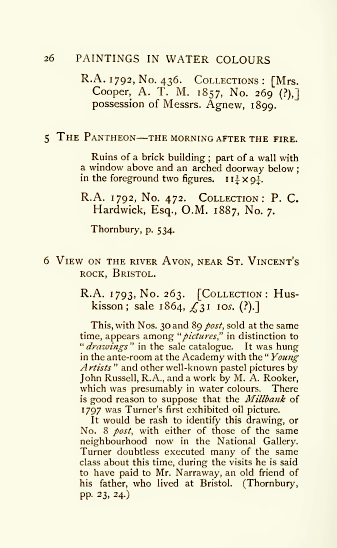
CF Bell page 26 No. 6
This section is being revised and updated see:
Errors
in CF Bell's Analysis of 'View on the river Avon, near St. Vincent's
rock, Bristol'
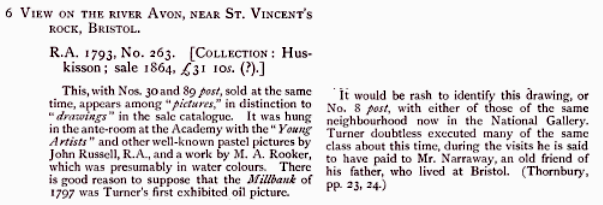
- "This, with numbers. 30 and 89 post, sold at the same time"
correct (partly): The three works were in the same sale:
- C.F.Bell 30; Lot 89; 'Remains of Waltham Abbey, Essex', exhibited
1796. (702,
Council Room)
- C.F.Bell 06; Lot 90; 'View on the river Avon, near St. Vincent's
rock, Bristol', exhibited 1793.
- C.F.Bell 89; Lot 91; 'Battle of the Nile, at 10 o'clock when the
L'Orient blew up, from the station of the gun boats between the
battery and castle of Aboukir'. exhibited 1799.(275,
Anti-Room)
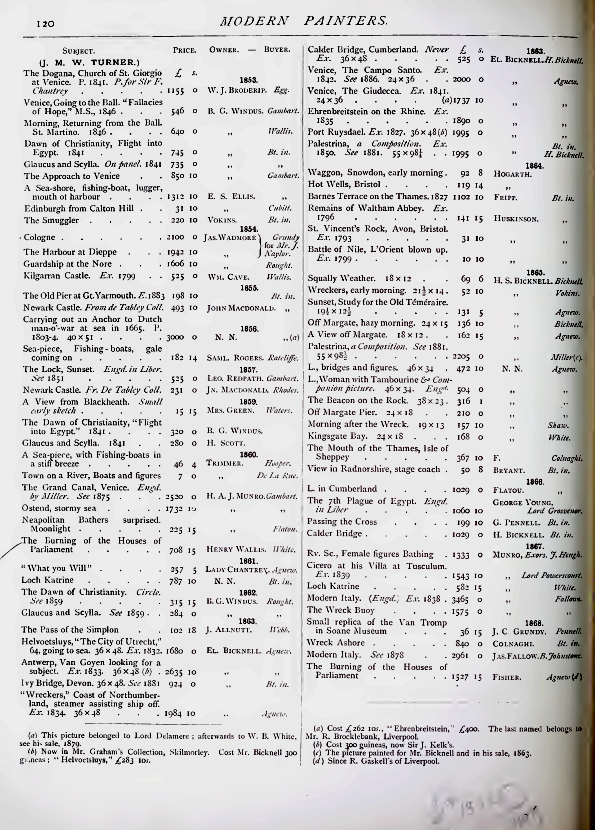
However, both Redford and a marked
up catalogue (V&A [Christie's
27th April 1864] ) show all three (together with Lots 92 to 95) as
'bought in', not 'sold'.
- "among pictures... in the sale catalogue"
wrong, it was in a separate section 'Property of a Gentleman'. This
section had in it both oils and watercolour-drawings.[Christie's
27th April 1864] but Redford
did include all three in oils.
- "It was hung ... with the 'Young Artists' ... John Russell RA"
wrong. The four John Russell pastels were hung on the East wall [The
Positions of John Russell's Pastils] . Turner's work was not
nearby, actually being on the opposite wall adjacent to a large John
Rising oil; an observer could not have seen the Turner and the Russells
together.(but Turner's work displayed on the west wall was the oil
,'The Rising Squall', not the watercolour-drawing 'View on the river
Avon, near St. Vincent's rock, Bristol').
- "... and a work by M.A.Rooker, which was presumably in water
colours."
wrong. Rooker* exhibited one watercolour in 1792 and two in 1793;
these were in the Antique Room. In 1792 he hung three oils and one in
1793 in the Great Room. Totals; four oils, three watercolous; providing
no grounds for a presumption that Rooker's work, 'Hastings cliff and
castle, Sussex' was "in water colours".
- "There is good reason to suppose the Millbank of 1797 was
Turner's first exhibited oil picture"
wrong, this comment relies on supposing a book written in 1866
could update a book written in 1874 (Redgrave Sequence - see Ch.III);
the reality of the situation is that the Redgraves concluded that 'The
Rising Squall' was the first exhibited oil in 1793.
- "It would be rash...." etc.
correct;. Underlying this comment is a presumption by C.F.Bell that
'View on the river Avon, near St. Vincent's rock, Bristol' was painted
at the Narraways - a presumption which is probably substantially correct
(at December 2020 there are still missing links in our provenance
for the Bristol Watercolour which is very likely to be the 1793 exhibit
'View on the river Avon, near St. Vincent's rock, Bristol')
However C.F.Bell's reference to Thornbury is practically irrelevant
in the context of 'View on the river Avon, near St. Vincent's rock,
Bristol', being a watercolour which was auctioned on 27th April 1864,
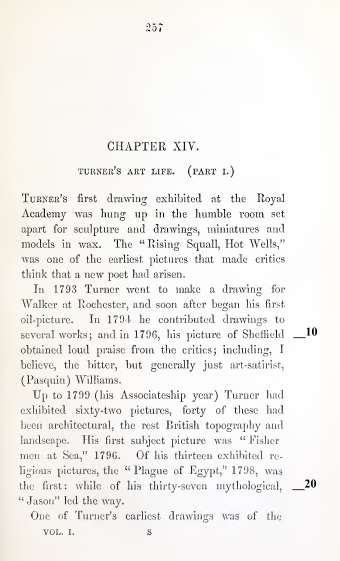
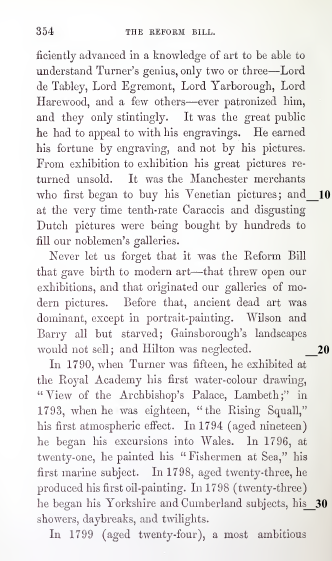
because the only other candidate (for first oil) mentioned by Thornbury
was 'The Rising Squall'. (Thornbury
1862, page 257 lines 4-5 (as a 'picture'),
page 354 line 24)
:
*M A Rooker No 271
There cannot possibly be a presumtion that No. 271 was a watercolour.
In 1792 Rooker exhibited three pictures in the Great Room (Nos. 47, 103 &
177) which must have been oils and one watercolour or drawing at No. 438
in the Antique Room. In 1793 No.124 was hung in the Great Room and
therefore an oil and two watercolours, Nos. 616 & 620 in the Antique
Room. [List
of Somerset House Exhibition Rooms and Exhibit Numbers]
**Turner was a new and practically unknown exhibitor. The only
justification for placing his work in the Anti-Room was because it was
an oil ... and, of course, for 1793 we now know from Edward Bell's
annotated catalogue (RA, AND/8/196) that (together with one doubtful
annotation of the George Beck) the Russells were the only
pastels/crayon/drawings in the Anti-Room.