BACKGROUND ~O~
The discovery of JMW Turner's oil on canvas exhibited at the Royal Academy
in 1793 ~O~ BACKGROUND
Turner's First Oil, his First Oils on Canvas and
'A Watermill' on Paper
No living person has seen oils 1,2,3,4(in its original form) or 5. Early oils were said (in 1835) to be 'differing in every quality from the characteristics of his present works.' No reliable source suggests that Turner painted in oil before or during his visit to Bristol in 1791. In 1793 he exhibited an oil, 'The rising squall, hot wells, from St. Vincent's rock, Bristol'. Canvas was purchased in Rochester in 1792*[1]. The quantity is unknown. A 'normal' purchase might be 'by the yard'. In January 1792 Turner had painted the Pantheon watercolour on paper approximately 15"x 20". A yard of canvas would be sufficient for four pictures of 15"x 20". Evidence for oils begins in 1792:
1. 'Sunset on the Thames Near the Red
House, Battersea'*[6]
Oil on paper or panel. 1792. Documented originally by Bell who saw
Turner painting it (his 'first attempt in oil') before the 'six weeks
tour' of Kent.
In 1792 ('six
weeks tour') canvas is purchased:
2. 'Rochester Castle and the Adjacent Grounds'*[1]
to [5]
The first oil on canvas (tentative size 15"x 20"). Painted
1792 in Rochester and remained with the Douglas household until given by
Margaret to her nephew between 1819 and 1845. Sold around 1845 to Dr.
William Hering. Unsuccessful auction at Christies 14th May 1860 lot 168.
Last known location Dr. William Hering at 14 Foley Place, London.
3. 'Rochester Castle with Fishermen Drawing
Boats Ashore In A Gale of Wind' *[6]
The second oil on canvas (tentative size 15"x 20"). Painted
1792. Started in Rochester and completed in Foots Cray where it became the
property of Rev. Robert Nixon and later passed to his son Dr. Francis
Russell Nixon, Bishop of Tasmania. Butlin and Joll Cat. No. 21 (which
retains Thornbury's erroneous dating and between editions, and updated for
the Nephew's letter*[1], failed to notice that
there were two pictures - one most definitely belonging to Nixon and the
other most definitely auctioned by Dr Hering.)
4. 'Self Portrait - Turner Age 16' *[7]
Possibly the third oil on Rochester canvas size 16"x 19".
Painted 1792 after Turner returned from the 'six weeks tour'*[6].
The present picture appears to have been repainted later. Originally, it
is said to have been painted by Turner from a small watercolour completed
at the Narraways in 1791. This demonstrates that, on his return from Kent,
Turner went back to 1791 material to continue exercises in oil.
Later in 1792
Turner is preparing his 1793 exhibits and he paints the oil intended for
the exhibition:
5. 'The rising squall, hot wells, from St. Vincent's rock,
Bristol'
'The 1793 Hotwells Oil' (being 'The St. Vincent's Rock Oil' as
shown herein), the fourth picture painted on Rochester canvas (which
had he bought one yard would now have run out). It is known that 'The St.
Vincent's Rock Oil' was oil on canvas size 15" x 20" unframed.
It is almost certain that it was painted on the stretcher and it is
possible that the stretcher was secondhand - it is certainly a peculiar
stretcher. The picture was exhibited then taken to the Rev. Robert Nixon
at Foots Cray.
Later in 1793
(after delivery of the picture to Foots Cray) or in 1794 Turner continues
to 'experiment' in oil:
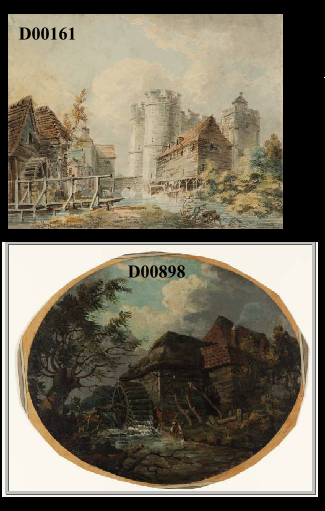
6. 'A Watermill'
D00898, Cat.No.19a in Butlin and Joll, oil on paper. The subject
appears to be the watermill at Canterbury D00161 visted during one of
Turner's 1793 visits.*[8]
In 1795:
7. 'A Portrait of Thomas Naylor Esq, Mayor of Liverpool'
This portrait was sold at
Christie's
6th March 1914. Although slightly later than the above it shows JMW
Turner working in oil before he exhibited 'Fishermen At Sea' in 1796. The
Christie's catalogue provides a definite size for this portrait; 29½
in. by 24½ in.
The transition from panel or paper (No. 1 above) to first canvas is easily explained. Turner's first purchase of canvas was in Rochester after the painting of 'Sunset on the Thames Near the Red House, Battersea'.*[1 & 2]. The question then arises as to why Turner did not continue to exhibit oil on canvas from that point on. Why did he return to London and paint 'A Watermill' on paper? Two things are known: i) Reviews compared 'The 1793Hotwells Oil' with Gainsborough (et al) and ii) The picture was aquired by Nixon. Furthermore no evidence has been found of public exhibition of this picture by Nixon (or his son) prior to the sales of 1864; at those sales there may have been authenticity issues; and following those sales the picture disappeared from the record. When Turner eventually did exhibit another oil on canvas there were changes in style. 'A Watermill' and 'The St. Vincent's Rock Oil' have little in common (a few similar but not identical brushstrokes in the clouds and on the water surface). It would not be unreasonable perhaps to speculate that Turner expecting praise from Nixon when delivering the picture instead met with adverse criticism prompting the delay of future canvases.
[_NEXT_]
20_10
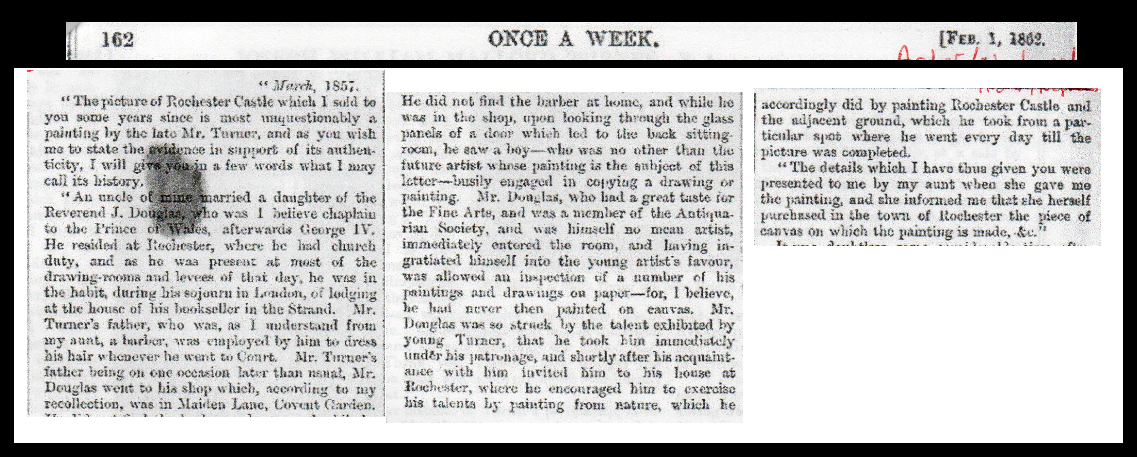
*[1]Archer, 'Once A Week', The Nephew's Letter To Dr. Hering
This letter gives the following information:
Rev. James Douglas met Turner in the Barber's shop at a time when Turner
had never painted on canvas.
'Shortly after' Rev. Douglas' first meeting with Turner, Douglas
invited Turner to Rochester.
Turner visited Rochester and a) became aquainted with the aunt,
Margaret Martha*[4] .(Rev. Douglas' daughter), and
b) purchased canvas. The letter does not say how much canvas was
purchased.
Turner painted the picture 'Rochester Castle and the Adjacent
Grounds'. He completed the picture whilst staying with Rev. Douglas.
He left that picture at the home and in the posession of Rev. Douglas
in Rochester.
The Rev. Douglas died (inf. 1819 in Sussex) and it is assumed that
the aunt (Rev. Douglas' daughter) inherited the picture.
The letter is written in March 1857. The nephew says 'sold you some
years since'. In *[3] below it seems likely that
Dr. Hering bought the picture around 1845-7
So some time between 1819 and 1845 the aunt gave the picture to the
nephew.
The Nephew was given the picture - he did not inherit it on
Margaret's death.
The letter does not say:
...how much canvas was purchased. (Possibly sold by the yard, widths
seem to vary from around 48" to 54" - no definitive data or
reference available)
. . . . . Turner may have cut 4 equal panels or 2 unequal panels
allowing 2 @ approx 22" wide and 2 @ 26" to32" wide each at
around 18" high. This would make sense if he initially wanted two
finished pictures at 15" x 20" (the 'Pantheon' size)
...that this was the only picture she gave to her Nephew (it may have
been part of a collection)
...that this was the only picture that Margaret posessed (she had
other relatives, her brother's children and may have given other pictures
to them)
...anything about stretchers. The picture was either painted flat,
like paper, (or Rev. Douglas may have given or lent him one. The latter
being unlikely because if Douglas had stretchers he would have canvas and
no purchase would be necessary)
*[2]Archer, 'Once A Week', The Complete Article
The complete article provides the following information:
The article reproduces the nephew's letter and names the first oil on canvas 'Rochester Castle and the Adjacent Grounds' but Archer says nothing about 'The rising squall, hot wells, from St. Vincent's rock, Bristol'. However as the inference is that 'Rochester Castle and the Adjacent Grounds' is Turner's first oil on canvas it must pre-date, 1793; 'The rising squall, hot wells, from St. Vincent's rock, Bristol'
The purchaser named here as Dr. H_ (Dr. William Hering*[3]) confronted Turner about the picture. Therefore the aunt, Margaret Martha Douglas, gave the picture to her Nephew before 19th December 1851 when Turner died. Dr. Hering later attempted unsuccessfully to sell the picture at Christies*[3].
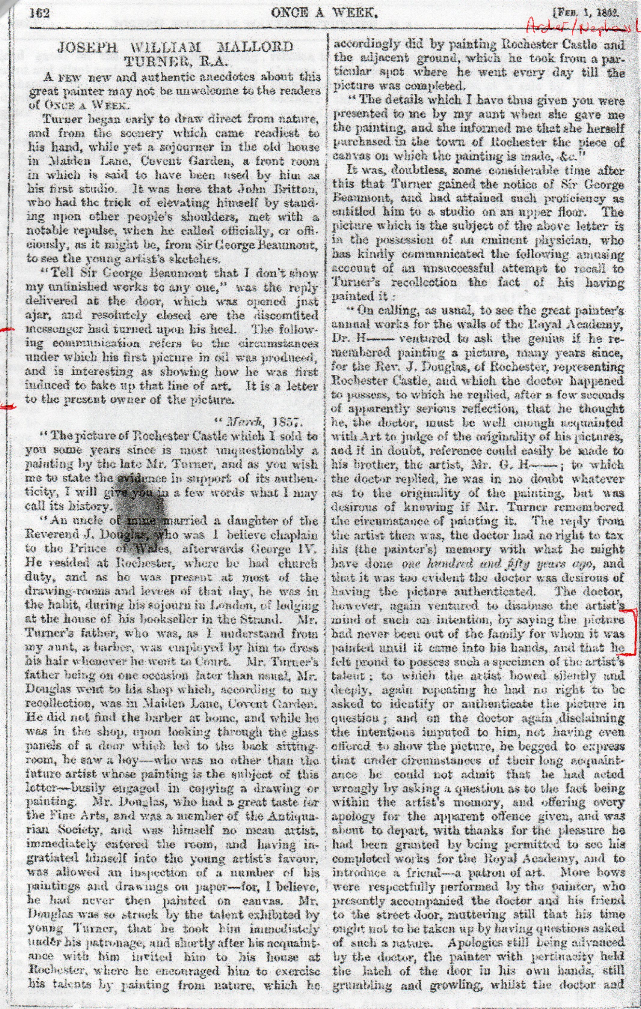
*[3]Christies unsuccessful sale of 'Rochester Castle':
Note that the given title (just, 'Rochester Castle') lacks any reference to marine subjects or weather.
Although Christies could give only the initial 'W' for Dr. Hering, he was traced as a Dr. William Hering, 14 Foley Place, London, born 1803, died 1876 Reigate, Surrey. Likely dates for meeting Turner were found to be 1845 and 1847.
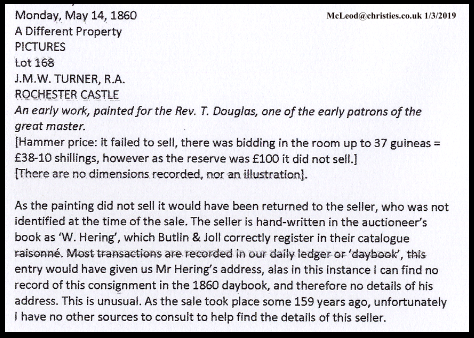
It is clear from Archer in 'Once A Week' and the 'Nephew's Letter' that this picture is 'Rochester Castle and the Adjacent Grounds'
Redford's 'A History of Art Sales', 1888 has been examined. There are sales recorded for 1860 (vol 2, page 120) but this sale does not appear there. Searches of https://archive.org have failed to find a catalogue for 14th May 1860.
Hering's address was found in an archived street directory which was a) partial and b) not available for download.
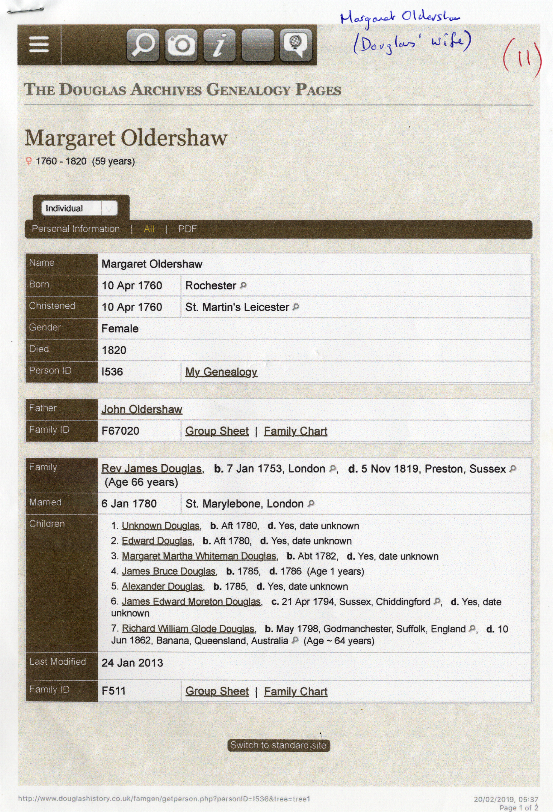
*[4]Rev. James Douglas & Family
Rev. James Douglas 1753-1819 is well documented on the internet and a search of his name gives many results (ensure that results refer to this Douglas (died 1919 Sussex)).
These extracts contain details of his wife and children
There is no further reliable evidence regarding the first child. There are claims that she married twice but both claims are definitely false. There is nothing to suggest that this child survived infancy or even existed.
The third child, a daughter, Margaret Martha (Whiteman) Douglas was born
around 1782. In 1792 she would be 10 or 11. In 1803 when the Rev. Douglas
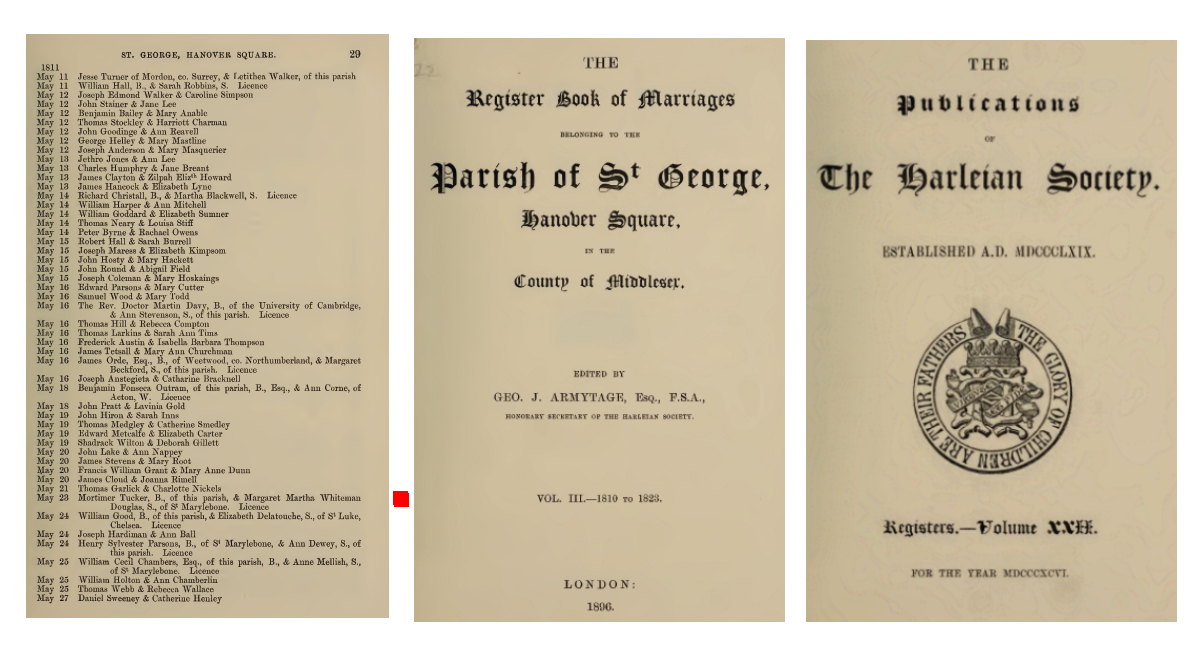
was appointed in Kenton, Suffolk she was 21. In 1811 she married Tucker -
she was 29. In 1819 when Rev. Douglas died she was 37. She gave the
picture between 1819 and 1845 (aged 63). The manner of the Nephew's
description of her suggests that she was dead by 1857 (age 75). Her date
of death is otherwise unknown. Examination of her age at these various
times suggests that:
. . . . . It is very unlikely that she alone bought the canvas at age
10 or 11. Turner's first oil exhibit was 1793 so his first canvas must
have been before 1793. He had no oil or canvas in 1791 at the Narraways
thus the canvas purchase was 1792. The inference is that Margaret (age 10
or 11) accompanied Turner (age 17) to Rochester when the canvas
was purchased.
. . . . . She may have married twice. The marriage to Tucker*[4]
is a 'late' marriage. The third name 'Whiteman' seems to have come from
nowhere and could be a remnant of a first marriage.One might expect the
daughter of a quite well connected clergyman to have a more elaborate
wedding - perhaps in one of her father's parishes.
*[5]Margaret Martha Douglas - Marriage to Tucker
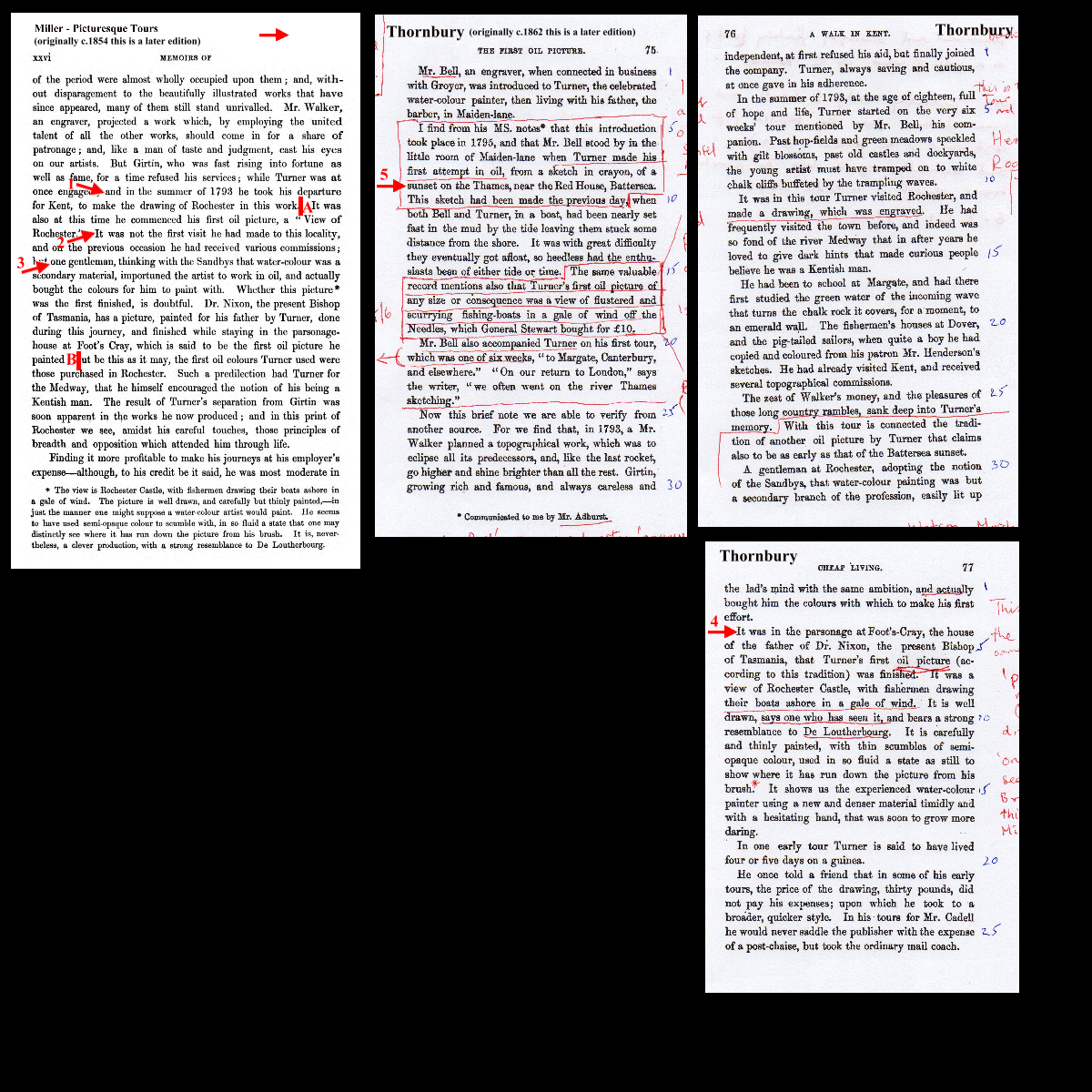
*[6]Miller and Thornbury
Miller's 'Turner and Girtin Picturesque Tours' describes two tours to
Kent (including Rochester).
. . . . . During the first tour (red arrow 2)(before the 1793 RA
Exhibition) two oils are mentioned:
. . . . . . . . . . (i) a 'commission' by a gentleman who bought the
paints (red arrow 3 - this is known to be Rev. James Douglas) and
. . . . . . . . . . (ii) a picture (described in Miller's footnote)
started in Rochester and finished in Foots Cray which remained with Rev.
Robert Nixon.
. . . . . During the second tour (red arrow 1), (after Turner's first
oil exhibit has been placed in the 1793 RA Exhibition), Turner made his
drawing for the (1794) engraving.
The first tour must be after the Pantheon fire of 14th January 1792
(because there was no mention of oils prior to the Pantheon exhibit) and
before January 1793 (approx) when the RA Exhibition oil was finished.
Therefore, for the Rochester pictures to be Turner's first oils (on
canvas), the first tour had to take place in 1792.
Archer *[1] to [5] gives details of the first picture: 'Rochester Castle and the Adjacent Grounds' (which became the property of Rev. Douglas, his daughter, Margaret then her Nephew the Dr. Hering)
Miller names the first oil picture as 'View of Rochester' but, in the footnote, describes the picture commenced in Rochester and finished in Foots Cray, 'Rochester Castle with Fishermen Drawing Boats Ashore In A Gale of Wind' (which became the property of Dr. Nixon's father, Rev. Robert Nixon, and later of Dr. Francis Russell Nixon himself).
Thornbury (red arrow 4) saw only one picture in Miller's commentary but neither Miller nor Thornbury knew that the first, earlier, picture had been given to Rev. Douglas.
Thornbury infers that Miller saw the Nixon picture. This is possible. Accounts have become interwoven over time but the purchase of canvas and painting of two Rochester oils in 1792 does seem clear.
Thornbury gives an impossible date of 1795 for the Bell introduction. (Following which the Thornbury account has Bell touring ('six weeks tour') with Turner in 1793 - two years before they met!). Royal Academy AND/8/67 is believed to be a sample of Bell's handwriting which looks too neat for a '2' to be misunderstood as a '5'. The only logical conclusion is that the meeting was 1792 before the first Rochester tour and that Bell's 'Sunset on the Thames Near the Red House, Battersea' was painted early 1792 before Turner had canvas. This leaves no explanation of the various accounts of how Turner 'bought' his first oil paints in Rochester. Either Nixon or Douglas (visiting Turner's father) could have supplied oil paint for Turner in which case the paint could have orriginated in Rochester as Miller suggests. However, when the Bell sunset was painted Turner had no canvas so it must have been on paper (like 'A Watermill' D00898) or on panel. The Bell sunset may be hiding in plain sight (as Butlin & Joll suggests) or it may have been destroyed.
The Bell Sunset could not be located on the Tate website - there appears to be no separate record of it. It is mentioned in passing in connection with 'Millbank' as it is in B&J. References to the 'Red House' found elsewhere and not individually recorded show that it was a tavern on the bank of the Thames but no exact detail of its location was found.
*[7]The Indianapolis Self Portrait
This picture is very well documented by Butlin and Joll, Indianapolis and Tate.
The references strongly suggest that the painting has been repainted, possibly over Turner's original.
If Turner initially painted this canvas on a piece of his Rochester canvas then the canvas could be the same as the candidate
But there are other possibilities
A complete 'copy' repaint on newer canvas
Turner's original could have been on panel (if so a piece of Rochester canvas may have remained after the 1793 exhibition ? B&J 8? ) and transferred to canvas later. Damage during the transfer would explain a total repainting later.
*[8] 'A Watermill', D00898 and its probable location.
D00898 bears some similarity to D00161 which is grouped with 'Watercolours of Oxford and the Home Counties 1791-3'. Being 'Canterbury the West Gate and Watermill from the River Stour 1792' it is likely that this was part of the work from which RA 1793 No. 316, 'Gate of St. Augustine's monastery, Canterbury' originated. However, Miller pointed out that there were two Kent tours; one in1793 and one earlier. 'Gate of St. Augustine's monastery, Canterbury' belongs to the earlier visit because it was exhibited RA 1793. D00161 could have been painted on either occasion.
The buildings are not quite the same and the tree has 'grown'.
[_NEXT_]
20_10