CUNNINGHAM EVIDENCE ~O~ The discovery of JMW Turner's oil on canvas exhibited at the Royal Academy in 1793 ~O~ CUNNINGHAM EVIDENCE
'The rising squall, hot wells, from
St. Vincent's rock, Bristol' was an Oil Exhibited RA 1793
Literary Evidence; Cunningham, Redgrave and Monkhouse
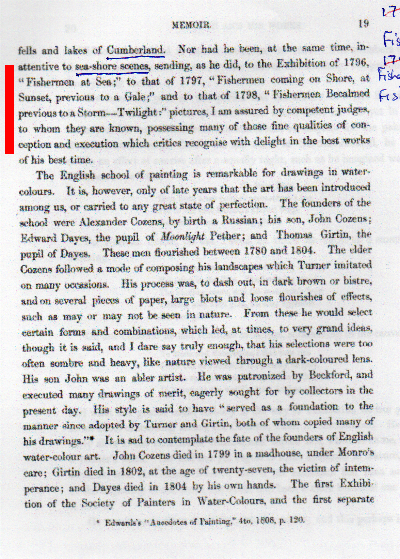
Literary evidence supports the proposition that Turner exhibited an oil picture in 1793.
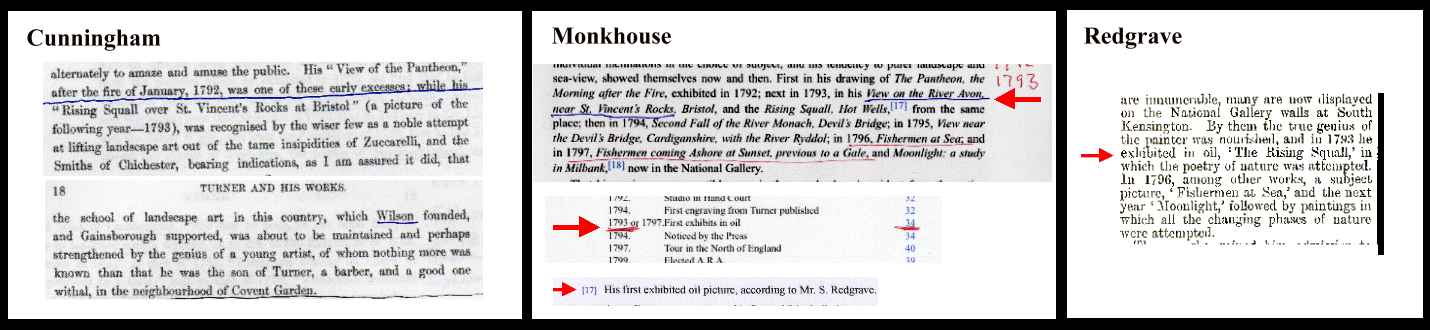
Cunningham's description (1852), its context and its vocabulary leave
little doubt that he is specifying an oil picture exhibited at the
Royal Academy Exhibition of 1793 which he called 'Rising Squall over
St. Vincent's Rocks at Bristol'*[1]*[2].
Monkhouse (1879) repeats this assertion calling the picture 'The Rising Squall, Hot Wells' *[7] stating his source as Samuel Redgrave who calls the picture 'The Rising Squall' *[8].
[_NEXT_]
07_00
Footnotes
*[1] In the short extract above
Cunningham mentions two works by Turner. This analysis shows that one is a
watercolour and the other an oil.
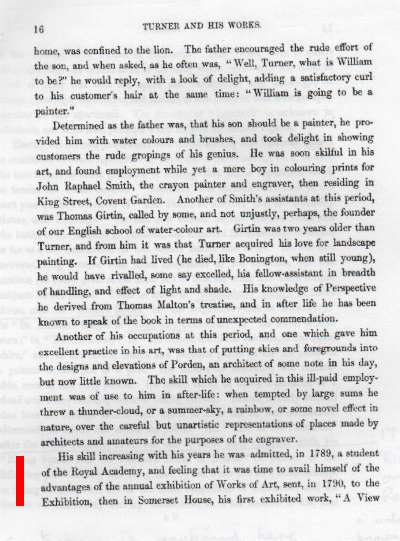
An examination of Cunningham's text from the bottom of page 16 to the
top of page 19*[2] reveals that he draws attention
to a number of works under the general heading of 'watercolour drawings'.
At the bottom of page 16 he writes,
'...his (Turner's)
first exhibited work, "A view of the Archbishop's Palace at
Lambeth."
The "View" was a watercolour drawing - as indeed most
of his early works were'. (note: 'most', not 'all'; 'work', not
'picture'.)
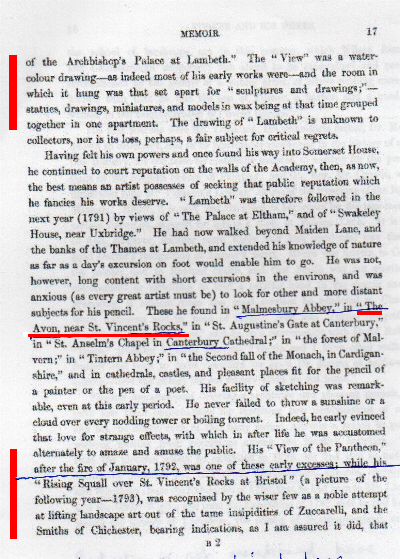
This statement crosses over the page onto page 17 where Cunningham
proceeds to list more watercolour drawings (including 'The Avon, near St.
Vincent's Rocks') with descriptive words such as 'works' and 'subjects for
his pencil'. Towards the bottom of page 17 there is a reference to "View
of the Pantheon" - reproduced in the short extract above - which is
known to be a watercolour drawing*[3]. The fire
destroyed the Pantheon on 14th January 1792 and Turners watercolour of it
was exhibited that year thus supporting Cunningham's dating of the oil,
'the following year' (1793).
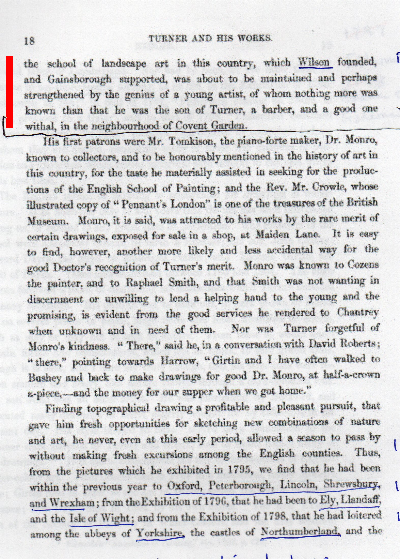
However, when, at the bottom of page 17 and top of page 18,
Cunningham descibes "Rising Squall over St. Vincent's Rocks at
Bristol" it is described as 'a picture', which, at this point,
slightly sets it apart from the 'watercolour drawings' already mentioned
and compares it to, inter alia, Gainsborough. His use of the word
'picture' is not reserved specifically for oils but it is the change in
terminology together with the comparison to Gainsborough that suggests
that he is now describing something different to a 'watercolour drawing'
and, in the phrase 'maintained and perhaps strengthened', perhaps
something special or moving on from or more important than a 'watercolour
drawing'. That would be an oil. A comparison to Gainsborough can be
meaningful only in the context of an oil. From the short extract it
appears that Cunningham's source was an eye witness who made the
comparison in 1793, five years after Gainsborough's death. At that time
public perception of Gainborough's work would be his greatest oils. (If
Cunningham himself was making the comparison in 1852 then it must likewise
be a comparison of oils for it is simply inappropriate to imply that a
watercolour-drawing could suggest 'genius' equal to or greater than
Gainsborough). For comparisons with Gainsborough and others see *[4].
It should also be noted that the watercolour 'The Avon, near St.
Vincent's Rocks' was also a 1793 RA Exhibit yet Cunningham merely groups
it together with all the other watercolours giving it no special status at
all.
The issue is not straightforward because Cunningham uses 'pictures' to describe the 1795 exhibits en bloc; none of Turner's 1795 exhibits were oils. However, on page 19, Cunningham lists three exhibited works; again describing them as 'pictures'. These three works are known to be oils. *[6]
There is additional evidence that 'Rising Squall over St. Vincent's Rocks at Bristol' is an oil. Again it is not straightforward because the additional evidence, the RA catalogue, shows that, of three works that Turner exhibited at the 1793 RA Exhibition, one was an oil but if that one was 'Rising Squall over St. Vincent's Rocks at Bristol' then the catalogue entries were inadvertantly transposed.(inf.)
*[2] Pages 16 - 19 of Peter Cunningham's 'Memoir' (please note that editions differ slightly)
*[3] Pantheon Watercolour 1792
Turner's 'The Pantheon, the morning after the fire' was painted after the fire of 14th January 1792 and exhibited at the 1792 RA Exhibition No. 472 in the Antique Room. Its size: 15" x 20" (is the same as the original size of the candidate picture). This information expands the Chronology*[5].
Turner's only other exhibit that year was 'Malmesbury Abbey' No. 436, also in the Antique Room. Malmesbury Abbey was painted from sketches made the previous year (1791) in the Bristol and Malmesbury Sketchbook. This exhibit must have been completed or near completion in January 1792 when the fire destroyed the Pantheon because clearly Turner stopped working on his planned exhibits and instead went out to sketch the ruined Pantheon and then went on to paint the finished Pantheon exhibit in time to have it accepted for exhibition that year. It is noted that at this time there were no other Bristol and Malmesbury exhibits ready for the 1792 exhibition. (In David Solkin's 'Art on the Line' there are references which indicate that the process of submitting works for exhibition was time consuming. The art work had to be finished and dry of course; it had to be mounted in a gilt frame which, for watercolours, would involve glazing; then there was the secretive practise whereby exhibits were allocated their exhibition rooms and numbers.)
'The Pantheon, the morning after the fire' was part of the Turner Bequest and there is no doubt that it is a watercolour (Tate: "Graphite and Watercolour on Paper").
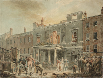 'The Pantheon, the morning after the fire' 1792 No. 472, Tate D00121,
watercolour drawing 15" x 20"
'The Pantheon, the morning after the fire' 1792 No. 472, Tate D00121,
watercolour drawing 15" x 20"
Watercolours and oils were not mixed, they were exhibited in different rooms. Exhibits in the Antique Room (in 1792) were watercolours.
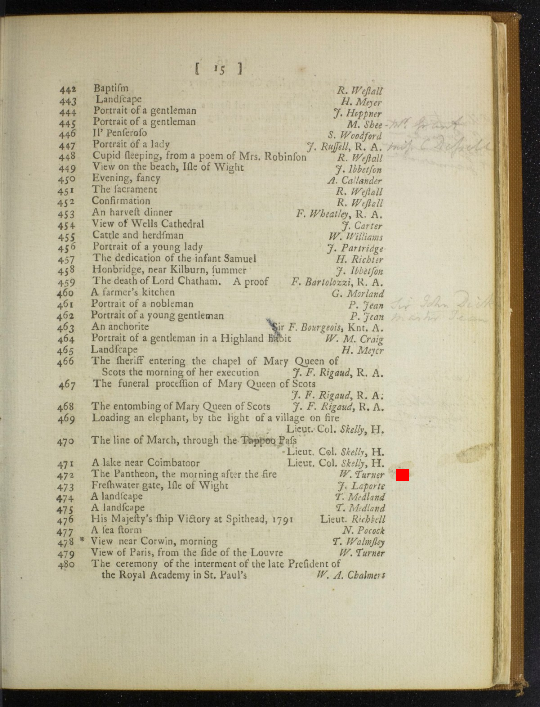 1792 Exhibition Catalogue page 5. Royal Academy
When Cunningham refers to this work its title is slightly different:
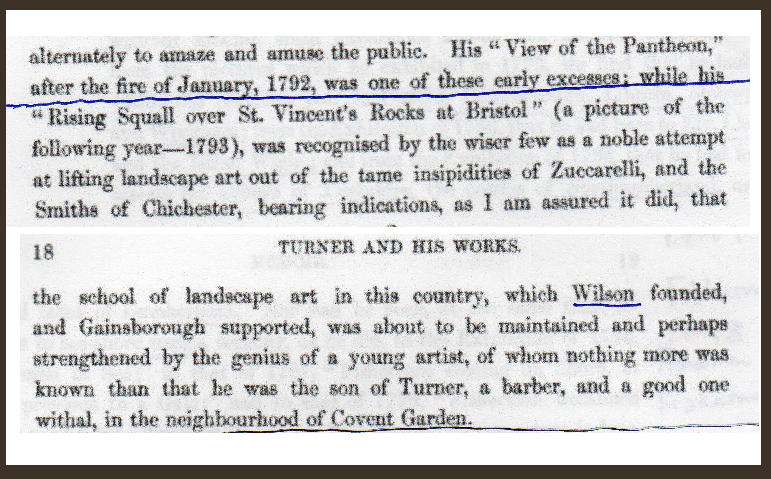 Cunningham
calls it 'View of the Pantheon'
Cunningham
calls it 'View of the Pantheon'
*[4] Comparisons with Gainsborough and Others
In these notes what becomes apparent and important is that the comparisons of 'Rising Squall over St. Vincent's Rocks at Bristol' were made with artists who were known for their oil paintings. If 'Rising Squall over St. Vincent's Rocks at Bristol' had been a watercolour there were plenty of contemporaneous, well established watercolour painters with whom Turner's work could be enthusiastically compared. Likewise, if the whole idea of 'a wiser few' recognising Turner's 'genius' was Cunningham's invention a comparison with oil painters not watercolourists indicates that 'Rising Squall over St. Vincent's Rocks at Bristol' was an oil and not a watercolour.
In pages 17 and 18 of Cunningham's memoir he sets out what appears to be a contemporaneous account of a picture which Turner exhibited at the Royal Academy Exhibition of 1793. Comparisons of Turner's picture (which Cunnungham calls 'Rising Squall over St. Vincent's Rocks at Bristol') are made with three of the 'great' artists of the period, Zuccarelli, Wilson and Gainsborough. Wilson had died in 1782, Zuccarelli and Gainsborough had died in 1788. Their reputations were therefore well established in 1793 and public perception of their art would be influenced by their great exhibited works not by minor sketches, pen and ink, or watercolour. The important works of these artists were oil paintings of which some examples are set out below.
These notes do not constitute an attempt to support the validity of Cunningham's comparisons. Cunningham was concerned with 'reporting' the views of his source(s) and it appears that Cunningham himself was stating an opinion; probably recorded in a newspaper or journal
'...was
recognised by the wiser few...'
'The wiser few' may be Cunningham's judgement of these critics and indicates that not all contemporaneous commentators agreed with the assertions made in these few lines.
It is impossible to know exactly which pictures Cunningham's sources were referring to. The examples here are randomly selected from reliable internet sources and displayed at a scale of one pixel representing 5mm. These were comparisons of a broad stylistic nature. Cunningham has not suggested that Turner (aged 17 when his oil was painted) actually 'copied' any features of these paintings. An image of the recently discovered candidate picture at the same scale is included (below the others) for comparison. NB: these comparisons were made in 1793 - none of Turner's now well known pictures existed at that time!
Gainsborough: The critique is clearly supportive of Gainsborough's work
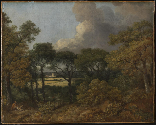 Gainsborough 1747, 'Wooded Landscape with a Peasant Resting' Tate N01283,
oil on canvas 24" x 31"
Gainsborough 1747, 'Wooded Landscape with a Peasant Resting' Tate N01283,
oil on canvas 24" x 31"
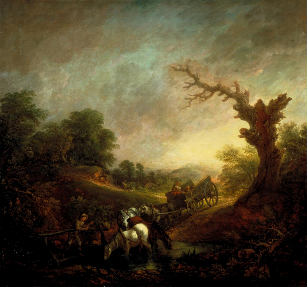 Gainsborough 1760, 'Carthorses Drunking at a Stream' Tate N00310, oil on
canvas 57" x 61"
Gainsborough 1760, 'Carthorses Drunking at a Stream' Tate N00310, oil on
canvas 57" x 61"
Wilson: The commentator or Cunningham (or both) describe him as the 'founder' of the 'school of landscape art'
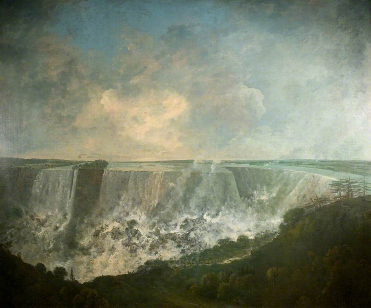 Wilson 1775 'Falls Of Niagara' Wolverhampton Art Gallery, oil on canvas 61"
x 73"
Wilson 1775 'Falls Of Niagara' Wolverhampton Art Gallery, oil on canvas 61"
x 73"
Tate N01891 is a smaller version (not a precise copy and of
indefinite attribution) of this work said to have been owned by Turner.
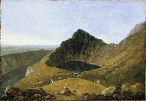 Wilson
1774 'Llyn-y-Cau, Cader Idris' Tate N05596, oil on canvas 20" x 29"
Wilson
1774 'Llyn-y-Cau, Cader Idris' Tate N05596, oil on canvas 20" x 29"
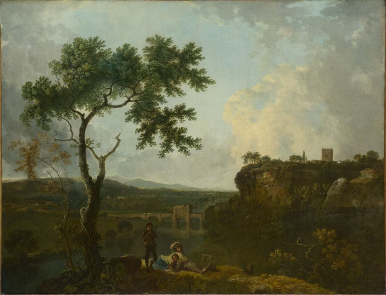 Wilson 1762 'Holt Bridge on the River Dee' NG6196, oil on canvas 58"
x 76"
Wilson 1762 'Holt Bridge on the River Dee' NG6196, oil on canvas 58"
x 76"
Zuccarelli: There is clear bias against Zuccarelli in the commentary
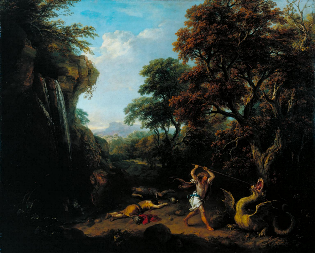 Zuccarelli 1765 'Cadmus Killing the Dragon' T04121, oil on canvas 50"
x 62"
Zuccarelli 1765 'Cadmus Killing the Dragon' T04121, oil on canvas 50"
x 62"
The candidate picture on the same scale
 1793
'Rising Squall Over St. Vincent's Rocks at Bristol' oil on canvas 14"
x 19" reduced from 15" x 20"
1793
'Rising Squall Over St. Vincent's Rocks at Bristol' oil on canvas 14"
x 19" reduced from 15" x 20"
*[5] Chronology of Events Leading Up To the Painting of the Candidate Oil
23 April 1775 Turner birth
23 April 1791 Turner 16th birthday
1791 Turner Visits Narraways in Bristol
1791 Turner sketched D00074 in the 'Bristol and Malmesbury
Sketchbook'
1791 Turner returned to London
1791 (a) Turner painted two small
watercolours based on his visit to Bristol D00389 and D00391
1791 (c) Turner painted Malmesbury Abbey
watercolour (based on his visit to Bristol) for RA exhibition
14 January 1792 Pantheon fire. Turner sketched and painted his
watercolour D00121 over the next few days or weeks
March 1792 Turner delivered to the RA Exhibition: 'Malmesbury Abbey'
No. 436
March 1792 Turner delivered to the RA Exhibition: 'The Pantheon, the
morning after the fire', D00121, No. 472
(b)
Notes on the chronology
(a) 1791 or 1792. The
order of D00389 and D00391 is not clear but they both include the dome
rock.
(b) The chronology will be expanded in later
notes.
(c) late 1791 or early 1792 but before
Turner's 1792 exhibits plans were interrupted by the Pantheon fire
*[6] Three later works mentioned by Cunningham are known to be oils
Cunningham details, 3 'pictures'
On page 19 Cunningham lists three exhibited works;
describing them as 'pictures'.
These three works are known to be oils.
1796 'Fishermen At Sea',
1797 'Fishermen coming on Shore, at sunset, previous to a Gale'
1798 'Fishermen Becalmed previous to a Storm - Twilight'
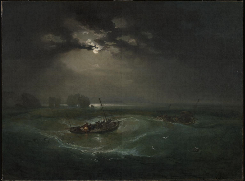 1796,
Tate, T01585
1796,
Tate, T01585
Butlin & Joll cat. 1; Oil on Canvas 36" x 48 1/8". RA Exhibition 1796 No. 305. Purchased by General Stewart for £10.
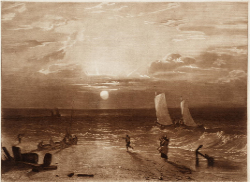 1797,
Lost, this image from Liber Studiorum, Tate A00991
1797,
Lost, this image from Liber Studiorum, Tate A00991
Butlin & Joll cat. 3; RA Exhibition 1797 No.279 changed to 344 (the picture was moved). Oil on canvas 36" x 48". This picture is known as 'The Mildmay Seapiece'. Engraving in Liber Studiorum. Original picture: LOST
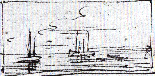 1799,
Lost, this impression from Calcott's sketch
1799,
Lost, this impression from Calcott's sketch
Butlin & Joll cat. 8; Oil on (probably) Canvas approx 15" x 30"(B&J-20" but 30" based on Callcott's sketch). RA Exhibition 1799 No. 55. LOST but Callcott made a sketch of it and noted its height (see B&J). Cunningham made a mistake in respect of the date because this title appears in the 1799 catalogue not the 1798.
*[7] Cunningham's evidence above supports the existance of the 1793 oil. Cunningham gives the name, the year (with certainty) and the context (as an oil) together in a single paragraph. Cosmo Monkhouse describes the same picture and calls it 'The Rising Squall, Hot Wells' and in a footnote 'his first exhibited oil picture according to Mr. S. Redgrave'*[8].
Monkhouse, chronology for 'First exhibits in oil' is uncertain as to whether this is 1793 or 1797. Here it is clear that Monkhouse is not relying on catalogue evidence because Turner's second oil exhibit was 1796 No. 305 'Fishermen At Sea' in the Anti-Room.*[2] Footnote [17] in the text against 'The Rising Squall, Hot Wells' refers to an account that this is Turner's first exhibited oil. Footnote [18] gives an alternative account. Note that the footnote [17] account shows that 'The Rising Squall, Hot Wells' was the oil (irrespective of whether it was exhibited or not) not 'View on the River Avon, near St. Vincent's Rocks'; furthermore note differences between these titles and Turner's titles in the catalogue.
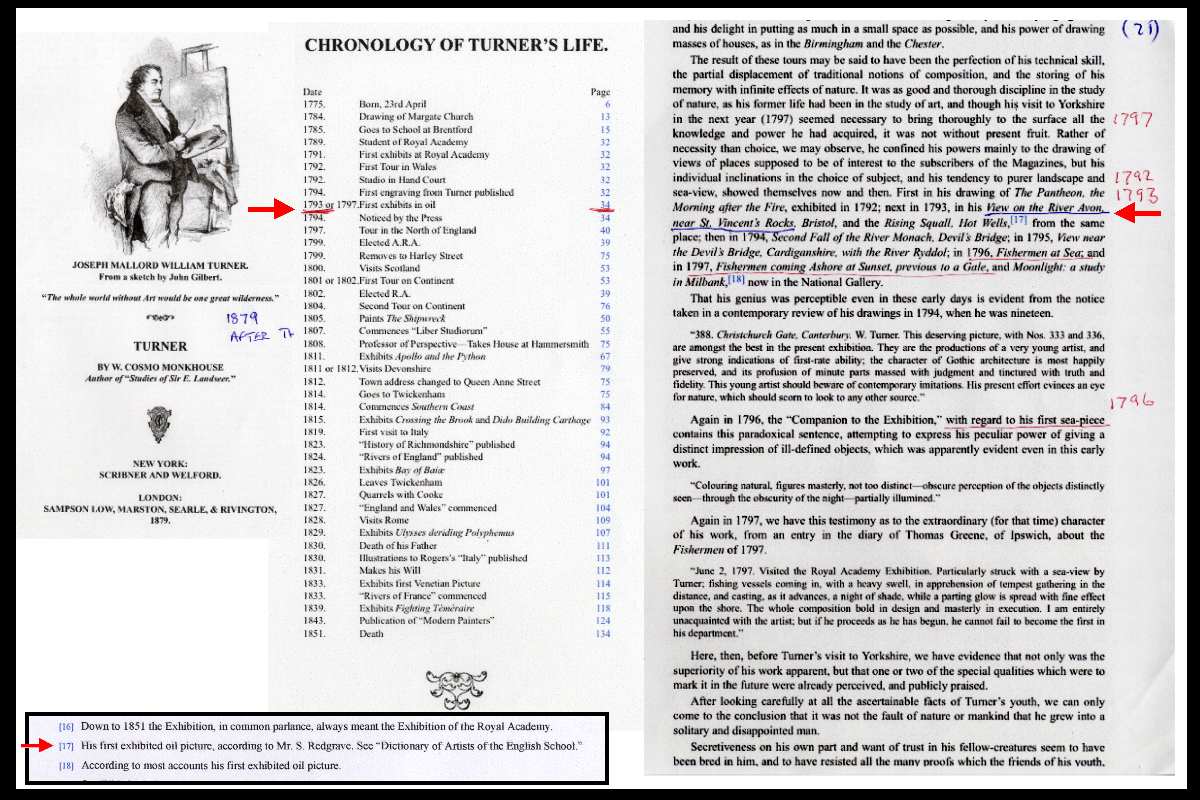
*[8]
Redgrave Sequence 1866 to 1905
1866 Richard and Samuel (writing 'A Century of Painters') examine the catalogues and conclude that Turner's first exhibited oil is 'Moonlight'.
1874 During the eight years since publication of 'A Century of Painters' Samuel discovered that Turner's first exhibited oil was 'The Rising Squall' in 1793 and that his second was 'Fishermen at Sea' in 1796. This information was published in 'A Dictionary of Artists'.
1878 A new edition of 'A Dictionary of Artists' was published after Samuel's death. (The first exhibit information was unchanged).
1879 Cosmo Monkhouse published 'Turner' and is uncertain about the first oil exhibit (see *[7] above).
1890 A new edition of 'A Century of Painters' was published (Samuel and Richard were both deceased) but the compilers failed to change Turner's information in respect of Samuel's discovery of 1874.
1901 C F Bell clearly looked at the latest editions and thought incorrectly that the information in 'A Century of Painters' (originating from 1866) was updating 'A Dictionary of Artists' (originating from 1874).
1905 Gilbert sets it out clearly in his 'History of Watercolour Painting in England'.
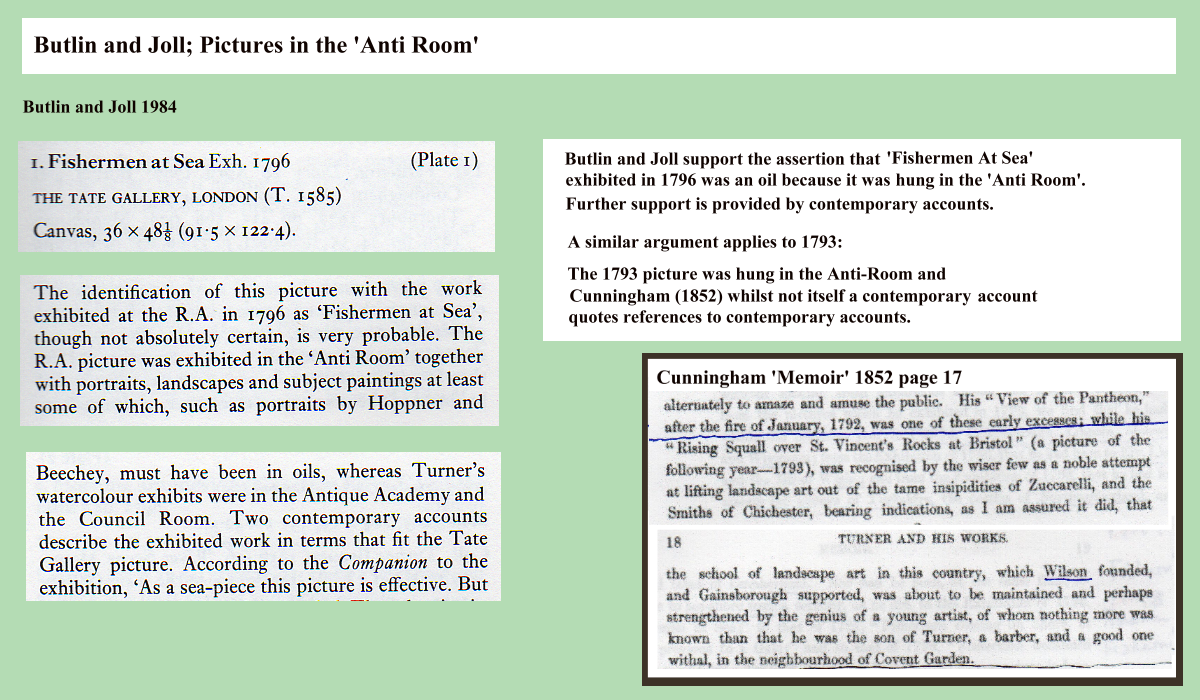
In 1984 Butlin & Joll set out the position for 1796 succinctly. Similar arguments apply to 1793. This may have been Samuel's reasoning in 1874 but he did not record it.
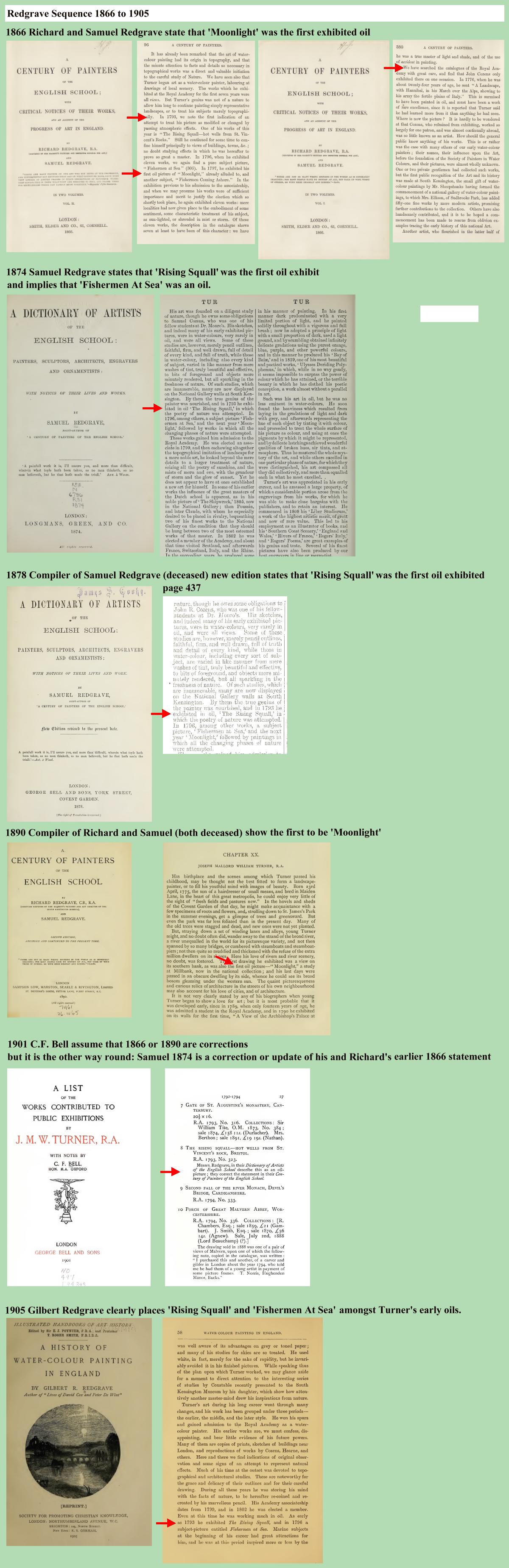
After 1905 and possibly due to the entry in C.F. Bell's 1901 publication 'A List Of Works contributed to Public Exhibitions by JMW Turner RA' the oil 'The Rising Squall' was dismissed in favour of the watercolour subsequently hung in Bristol Museum.
07_00