St. Vincent's Rock Complex - Turner Version - in the Watercolour and in the oil
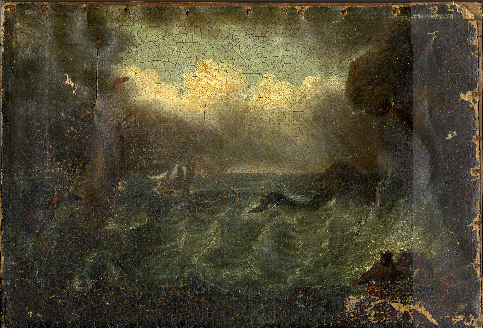
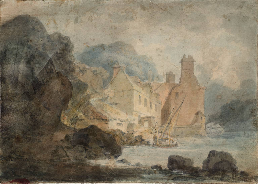
Both Turner's watercolour D00389 and the candidate oil on canvas portray his 'St. Vincent's Rock' complex consisting of an overhanging rock and a dome rock with a little hump on top. The two paintings show the rock complex from opposite directions. The watercolour was probably painted a year before the oil either whilst Turner was in Bristol with the Narraways or shortly afterwards. The watercolour was derived from a sketch, D00074, made in Bristol in 1791. The sketch does not show this rock complex. [_SKETCH_AND_WATERCOLOUR_]...[_BACK_VIEW_SKETCH_]
Although not 100% certain:
This rock complex does not appear anywhere else. The two components
appear separately in other work but not together. It appears that Turner
invented this rock complex to dramatize 'St. Vincent's Rock'.
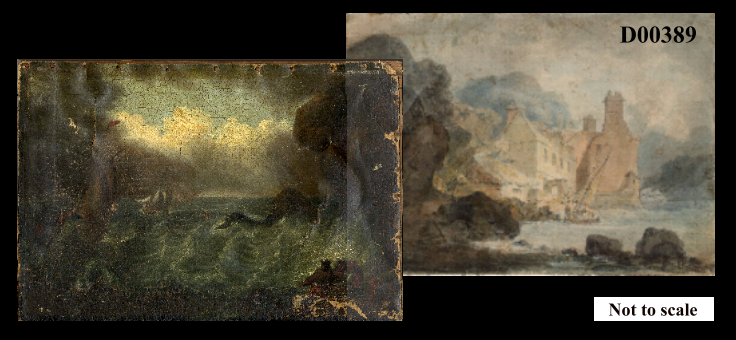
Here the oil and the watercolour are shown next to each other at a scale of one pixel per mm. The rock complex on the right of the oil is the same as the rock complex on the left of the watercolour from the opposite direction, that is: in the oil the view is from the Hot Wells riverbank, in the watercolour the view is looking over the river towards the Hot Wells riverbank.
Here the pictures are not to scale but displayed showing the rock
complex at approximately the same size on the screen.The overhanging rock
and domed rock are almost mirror images. The proximity of the rock
complex to the Hot Wells building leaves no doubt that the rock complex
is (or is intended to be) St. Vincent's Rock.
Note that the wave crests in the two paintings both run perpendicular to the (Hot Wells) riverbank possibly as a result of a prevailing south-westerly wind.
please use your browser's 'back' button to return to the previous page.
or:
[_BACK_VIEW_SKETCH_] Turner's 1791 sketch of the back view of Hot Wells does not show the rock complex.