Peter Cunningham
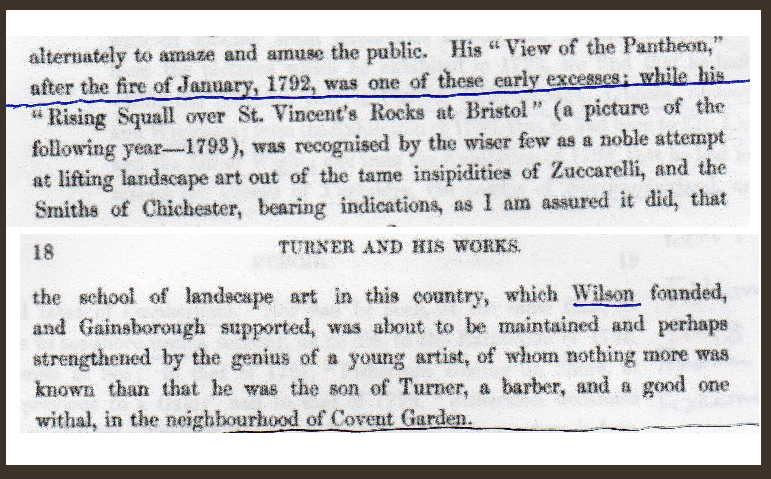
Peter Cunningham described a 1793 oil by Turner and
referred to it as
'Rising Squall over St. Vincent's Rocks at Bristol'.
These notes refer to Peter Cunningham's Memoir, preface
to John Burnet's 'Turner And His Works', published 1852.
[_MEMOIR_PAGES_16_TO_19_]
'Rising Squall over St. Vincent's Rocks at Bristol' is an oil:
In the short extract above Cunningham mentions two works by Turner. This analysis shows that one is a watercolour and the other an oil. An examination of Cunningham's text from the bottom of page 16 to the top of page 19 reveals that he highlights a number of works under the general heading of 'watercolour drawings'. At the bottom of page 16 he writes,
'...his (Turner's)
first exhibited work, "A view of the Archbishop's Palace at
Lambeth."
The "View" was a watercolour drawing - as indeed most
of his early works were'. (note: 'most', not 'all'; 'work', not
'picture'.)
This statement crosses over the page onto page 17 where Cunningham
proceeds to list more watercolour drawings (including 'The Avon, near St.
Vincent's Rocks') with descriptive words such as 'works' and 'subjects for
his pencil'. Towards the bottom of page 17 there is a reference to "View
of the Pantheon" - reproduced in the short extract above - which is
known to be a watercolour drawing. [_PANTHEON_WATERCOLOUR_]
However, when, at the bottom of page 17 and top of page 18,
Cunningham descibes "Rising Squall over St. Vincent's Rocks at
Bristol" it is described as 'a picture', which, at this point,
slightly sets it apart from the 'watercolour drawings' already mentioned
and compares it to, inter alia, Gainsborough. His use of the word
'picture' is not reserved specifically for oils but it is the change in
terminology together with the comparison to Gainsborough that suggests
that he is now describing something different to a 'watercolour drawing'
and, in the phrase 'maintained and perhaps strengthened', perhaps
something special or moving on from or more important than a 'watercolour
drawing'. That would be an oil. A comparison to Gainsborough can be
meaningful only in the context of an oil. From the short extract it
appears that Cunningham's source was an eye witness who made the
comparison in 1793, five years after Gainsborough's death. At that time
public perception of Gainborough's work would be his greatest oils. (If
Cunningham himself was making the comparison in 1852 then it must likewise
be a comparison of oils for it is simply inappropriate to imply that a
watercolour-drawing could suggest 'genius' equal to or greater than
Gainsborough). [_COMPARISONS_WITH_GAINSBOROUGH_AND_OTHERS_]
The issue is not straightforward because Cunningham uses 'pictures' to describe the 1795 exhibits en bloc; none of Turner's 1795 exhibits were oils. However, on page 19, Cunningham lists three exhibited works; again describing them as 'pictures'. These three works are known to be oils. [_THREE_PICTURES_]
There is additional evidence that 'Rising Squall over St. Vincent's Rocks at Bristol' is an oil. Again it is not straightforward because the additional evidence, the RA catalogue, shows that, of three works that Turner exhibited at the 1793 RA Exhibition, one was an oil but if that one was 'Rising Squall over St. Vincent's Rocks at Bristol' then the catalogue entries were inadvertantly transposed.[_TURNERS_1793_EXHIBITS_]
Cunningham states that the exhibition year is 1793.
It is certain that this is correct:
In [_THREE_PICTURES_](above)
it was shown that Cunningham made a mistake when quoting 1798 as the
exhibition year for 'Fishermen Becalmed previous to a Storm - Twilight'.
The correct year was 1799. This indicates that Cunningham did not refer to
exhibition catalogues when writing his 'Memoir'. So can the year 1793 be
relied upon for the year of exhibition of 'Rising Squall over St.
Vincent's Rocks at Bristol'?
Looking again at the short extract above, Cunningham refers twice to
the year. It is first referred to as the year following the year of the
Pantheon fire and second actually written as '1793'. The Pantheon fire is
well documented and without doubt happened on 14th January 1792.
[_PANTHEON_FIRE_]
Evidence (mentioned above) in the 1793 Royal Academy Exhibition
catalogue supports Cunningham's statement. It is shown that Turner
exhibited an oil that year in the 'Anti-Room'. [_TURNERS_1793_EXHIBITS_].
The year '1793' in Cunningham's statement is therefore, beyond reasonable
doubt, accurate.