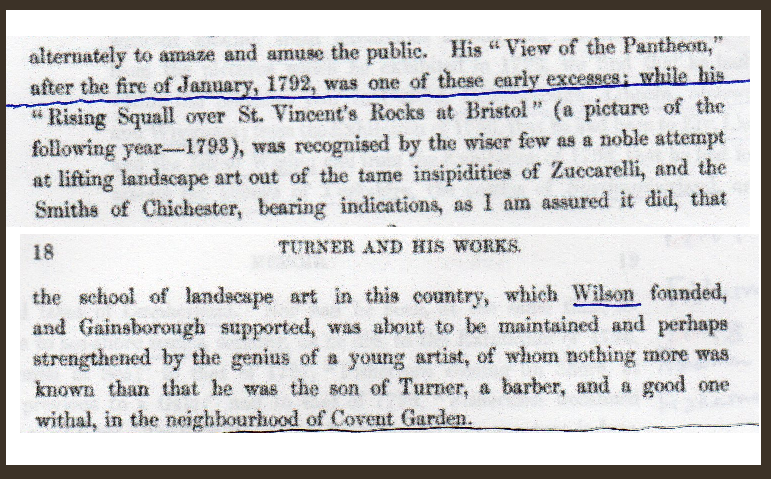
 '...was
recognised by the wiser few...'
'...was
recognised by the wiser few...'Comparisons with Gainsborough and Others
In these notes what becomes apparent and important is that the comparisons of 'Rising Squall over St. Vincent's Rocks at Bristol' were made with artists who were known for their oil paintings. If 'Rising Squall over St. Vincent's Rocks at Bristol' had been a watercolour there were plenty of contemporaneous, well established watercolour painters with whom Turner's work could be enthusiastically compared. Likewise, if the whole idea of 'a wiser few' recognising Turner's 'genius' was Cunningham's invention a comparison with oil painters not watercolourists indicates that 'Rising Squall over St. Vincent's Rocks at Bristol' was an oil and not a watercolour.
In pages 17 and 18 of Cunningham's memoir he sets out what appears to be a contemporaneous account of a picture which Turner exhibited at the Royal Academy Exhibition of 1793. Comparisons of Turner's picture (which Cunnungham calls 'Rising Squall over St. Vincent's Rocks at Bristol') are made with three of the 'great' artists of the period, Zuccarelli, Wilson and Gainsborough. Wilson had died in 1782, Zuccarelli and Gainsborough had died in 1788. Their reputations were therefore well established in 1793 and public perception of their art would be influenced by their great exhibited works not by minor sketches, pen and ink, or watercolour. The important works of these artists were oil paintings of which some examples are set out below. Comparisons for the 'Smiths' are not yet included because the writer is unclear as to the exact reference here.
These notes do not constitute an attempt to support the validity of Cunningham's comparisons. Cunningham was concerned with 'reporting' the views of his source(s) and it appears that Cunningham himself was merely stating an opinion; probably recorded in a newspaper or journal [_CONTEMPORANEOUS_REPORTS_OF_RA_EXHIBITS_].
'...was
recognised by the wiser few...'
'The wiser few' may be Cunningham's judgement of these critics and indicates that not all contemporaneous commentators agreed with the assertions made in these few lines.
It is impossible to know exactly which pictures Cunningham's sources were referring to. The examples here are randomly selected from reliable internet sources and displayed at a scale of one pixel representing 5mm. These were comparisons of a broad stylistic nature. Cunningham has not suggested that Turner (aged 17 when his oil was painted) actually 'copied' any features of these paintings. An image of the recently discovered candidate picture at the same scale is included (below the others) for comparison. NB: these comparisons were made in 1793 - none of Turner's now well known pictures existed at that time.
Gainsborough: The critique is clearly supportive of Gainsborough's work
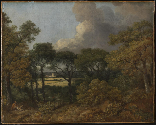 Gainsborough 1747, 'Wooded Landscape with a Peasant Resting' Tate N01283,
oil on canvas 24" x 31"
Gainsborough 1747, 'Wooded Landscape with a Peasant Resting' Tate N01283,
oil on canvas 24" x 31"
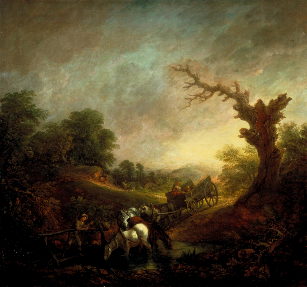 Gainsborough 1760, 'Carthorses Drunking at a Stream' Tate N00310, oil on
canvas 57" x 61"
Gainsborough 1760, 'Carthorses Drunking at a Stream' Tate N00310, oil on
canvas 57" x 61"
Wilson: The commentator or Cunningham (or both) describe him as the 'founder' of the 'school of landscape art'
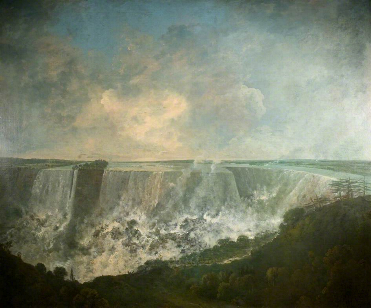 Wilson 1775 'Falls Of Niagara' Wolverhampton Art Gallery, oil on canvas 61"
x 73"
Wilson 1775 'Falls Of Niagara' Wolverhampton Art Gallery, oil on canvas 61"
x 73"
Tate N01891 is a smaller version (not a precise copy and of
indefinite attribution) of this work said to have been owned by Turner.
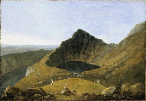 Wilson
1774 'Llyn-y-Cau, Cader Idris' Tate N05596, oil on canvas 20" x 29"
Wilson
1774 'Llyn-y-Cau, Cader Idris' Tate N05596, oil on canvas 20" x 29"
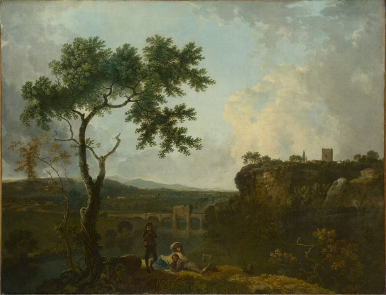 Wilson 1762 'Holt Bridge on the River Dee' NG6196, oil on canvas 58"
x 76"
Wilson 1762 'Holt Bridge on the River Dee' NG6196, oil on canvas 58"
x 76"
Zuccarelli: There is clear bias against Zuccarelli in the commentary
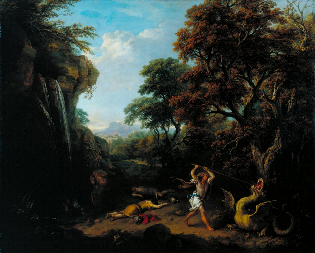 Zuccarelli 1765 'Cadmus Killing the Dragon' T04121, oil on canvas 50"
x 62"
Zuccarelli 1765 'Cadmus Killing the Dragon' T04121, oil on canvas 50"
x 62"
The Smiths are not yet included on this page for the reason stated above
The candidate picture on the same scale
 1793
'Rising Squall Over St. Vincent's Rocks at Bristol' oil on canvas 14"
x 19" reduced from 15" x 20"
1793
'Rising Squall Over St. Vincent's Rocks at Bristol' oil on canvas 14"
x 19" reduced from 15" x 20"
More information: [_IMAGE_COMPARISONS_]