THORNBURY ANALYSIS re: Oil or Watercolour
This page seeks only to establish Thornbury's view as to whether 'The Rising Squall' was an oil or a watercolour-drawing.
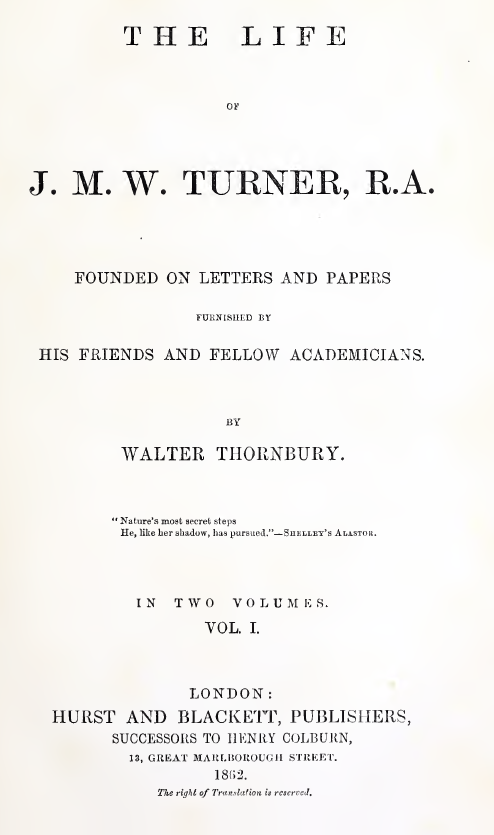
Thornbury 1862 mentions 'The Rising Squall' twice in the text of volume 1 and once in the list of exhibited work in volume 2.
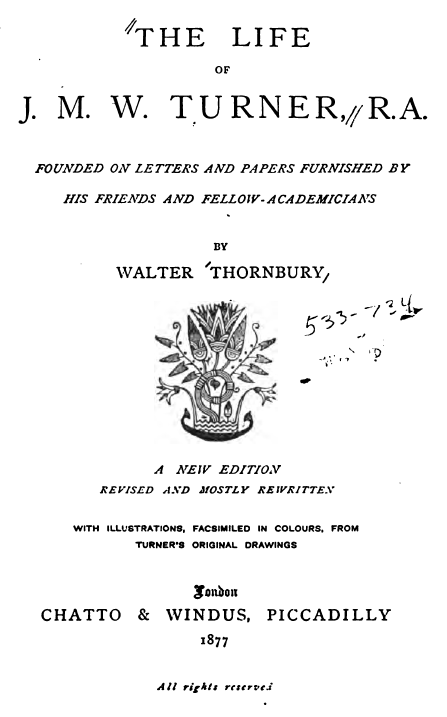
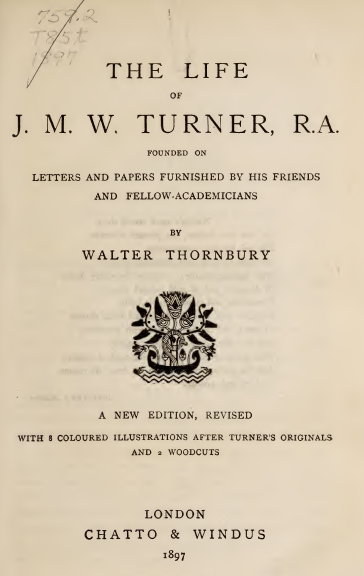
The (first) 1862 edition was followed by two revised editions. An 1877 edition was published just after Thornbury's death. Another edition, very similar to the 1877, was published in 1897.
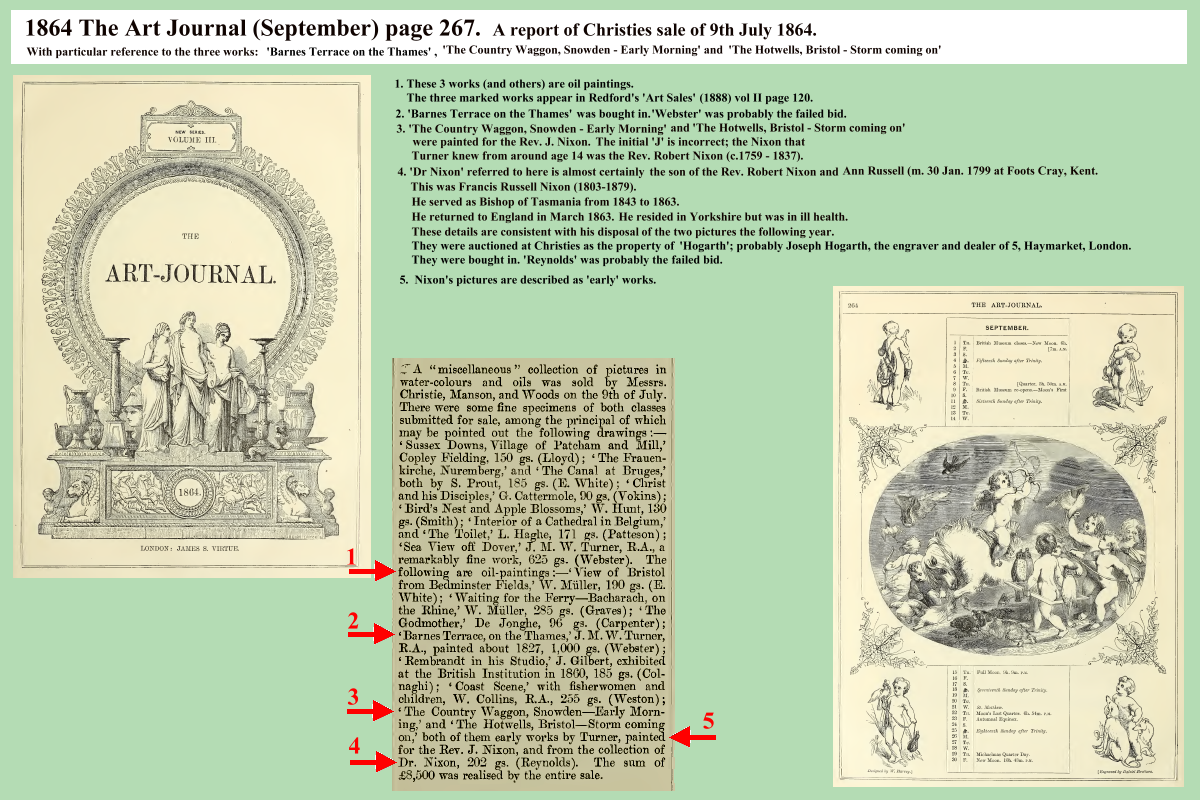
The first appearance of 'The Rising Squall' at auction took place on 9th July 1864 reported in the Art Journal providing a direct reference to the picture as an oil. Cunningham's 'Memoir' was published in 1852. Cunningham makes it clear that 'The Rising Squall' was an oil but Thornbury compiling his material in the years before 1862 had no direct reference to the actual picture. Whilst he never says that 'The Rising Squall' is a watercolour-drawing we must conclude that there is no definitive view expressed by Thornbury.
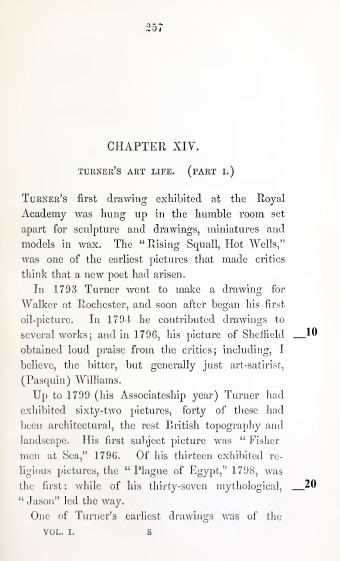
1862 Volume 1; Chapter XIV, Turner's Art Life (Part I)
In this section Thornbury is so contradictory that no definite conclusion can be drawn.
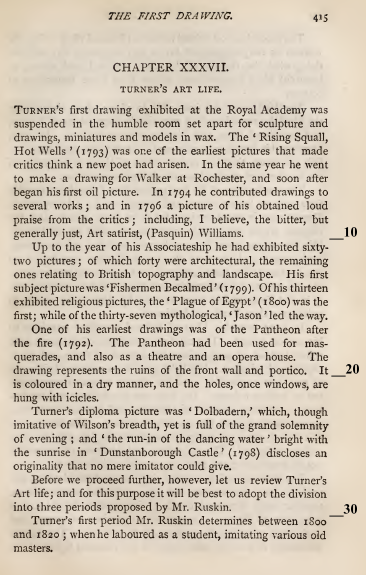
He begins by describing 'The Rising Squall' as a "picture"
(p257 line 4). In normal terminology of the time this would be an oil. He
goes on to describe the Walker commission as a 'drawing' (p257 line 7);
thus in the first seven lines of his introduction Thornbury has drawn the
usual distinction between picture and drawing.
However, he then introduces the term "oil-picture" (p257
line 9) which raises uncertainty as to what he meant by 'picture'.
Thornbury continues, "In 1794 he contributed..." drawings, ..."and in 1796 his picture of Sheffield" citing a critique by Pasquin. It is difficult to know what Thornbury meant by 'contributed'. If he meant 'contributed to the 1796 RA exhibition' then this is an extraordinary claim because there was no picture or drawing of Sheffield exhibited in 1796 and furthermore there is no mention of Turner at all in Pasquin's 1796 'Memoirs of the Royal Academicians'. If he meant 'contributed to Walker's portfolio of drawings then his claim to "loud praise from the critics" is equally extraordinary; a Sheffield drawing from around this time certainly exists, a little 4"x 6" watercolour-drawing now in the posession of Sheffield Galleries and Museum Trust and a plate identical to it appears in Miller's publication of 1854 very likely from Walker's commission (a copy is held by Tate as T05904).
Therefore by line 14 there is some uncertainty and unreliability in Thornbury's writing.
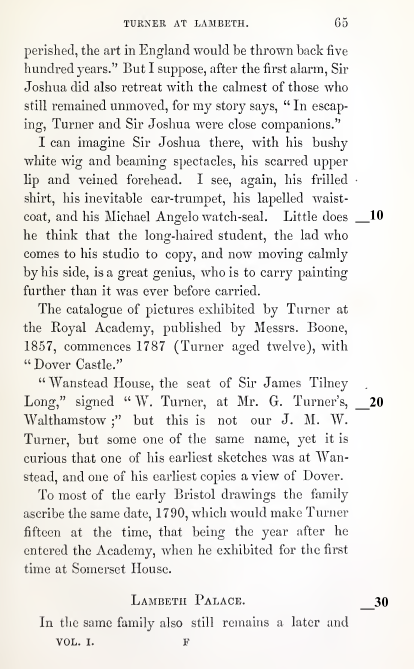
Thornbury's narrative then jumps to 1799 where he says that Turner had exhibited sixty-two pictures. There were only sixty. It is possible that Thornbury wrote this section originally counting two earlier exhibits by a 'Turner' who was not 'JMW'; these can be found in vol 1 page 65 line 15.
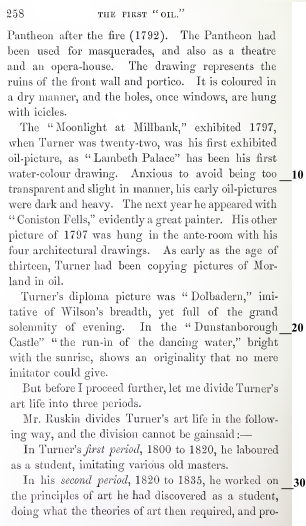
On page 258 after a mention of 'The Pantheon', Thornbury states that 'Moonlight' was Turner's first exhibited 'oil-picture' in 1797 (line 7). On line 13 he says, "His other picture of 1797 was hung in the anti-room with his four architectural drawings". Tis other picture was 'Fishermen Coming A Shore At Sun Set, Previous To A Gale' (the Mildmay) which was initially hung in the Great Room but swapped with a work in the Anti-Room following a dispute with Sir F Bourgeois RA. The fact that the Mildmay was initially in the Great Room shows beyond doubt that it was an oil and the fact that it was then placed in the Anti-Room shows beyond doubt that the Anti-Room was a place in which oils were hung and therefore Thornbury's statement that 'Moonlight' was the first exhibited oil is self defeating; there were two oils exhibited in 1797 so neither alone can be said to be the first. He said that the Mildmay was exhibited, "in the anti-room with his four architectural drawings". Readers might therefore assume that there were four architectural drawings by JMW Turner in the Anti-Room in 1797. These drawings were not hung in the Anti-Room; they were hung in the Council Room. This confused paragraph then ends by apparently stating that Turner had been working in oil since the age of thirteen (albeit copies of Morland) having stated on page 257 line 8 that Turner's first oil had been started in 1793.
In Thornbury's defence it could be said that he recognized the contradictions and attempted to 'correct' them in his second edition published in 1877, just after his death, but it is clear that the material for the second edition was all derived from the first and is therefore just as unreliable.
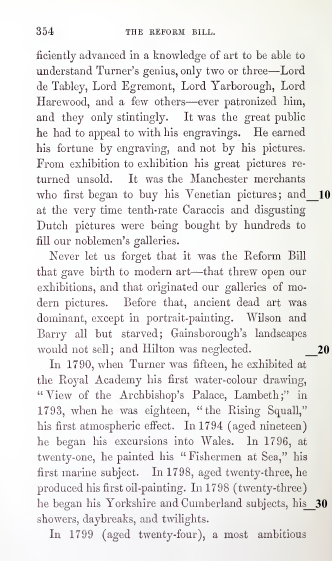
1862 Volume 1 page 354, Chapter XXII, Turner's Notebooks and Sketches
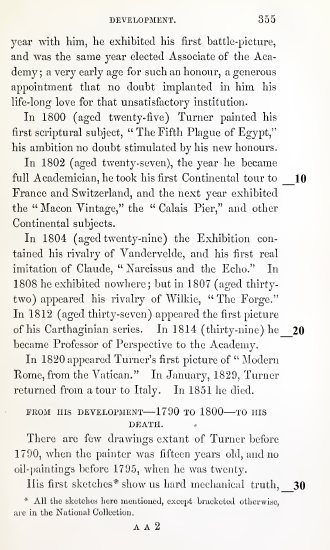
On page354 line 24 Thornbury appears to be saying that 'The Rising Squall' was exhibited in 1793. In line 29 he states that JMW Turner 'produced his first oil-painting' in 1798 suggesting that works prior to 1798 were not oils. Thornbury may have meant 'produced at exhibition' but even that would be wrong because in the 1797 RA Exhibition 'Moonlight' was hung in the Great Room and 'Mildmay' was initially hung in the Great Room; these were therefore, without doubt, oils.
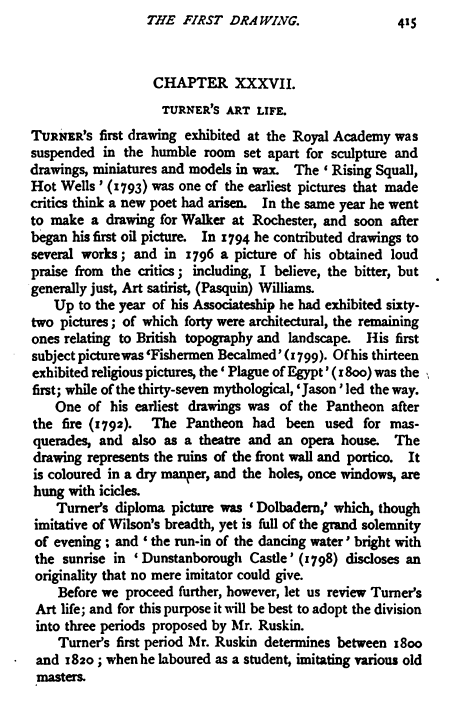
1897; Chapter XXXVII, Turner's Art Life
In the revised editions (see 1877 page 415 see 1897 page 415 ) the material presented in the 1862 edition page 257 is repeated with minor changes.