


Introduction: Squall at St Vincent's Rock, Bristol:
Evidence that the rock complex in this landscape was invented by JMW
Turner
Squall at St Vincent's Rock, Bristol
Evidence that the rock complex in this landscape was invented by JMW
Turner
- The environs of
Hotwells, St. Vincent's Rock, Bristol (18th century to the present)
A study of photographs, drawings and descriptive texts.
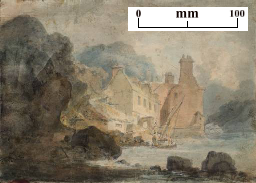
It emerges that the rock complex painted by JMW Turner on D00389 is
his own invention.
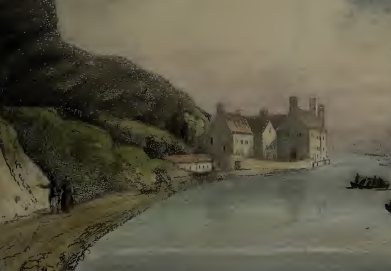
Ibbetson's realistic and scientific drawing of the back view of
Hotwells House in 1792 (left) shows no trace of the rock complex that
Turner painted on D00389 (right).
 ...
...
...
- Bristol
Museum and Art Gallery online catalogue K6431
A study of the images in the online catalogue of Bristol Museum and
Art Gallery likewise produced images of Hotwells and St. Vincent's Rock
without Turner's rock complex. More evidence that JMW Turner invented
scenes during his visits to Bristol emerged in an exchange of e-mails
with Bristol Museum which drew attention, in particular, to another
invented scene from that period; K6431.
"The dramatic view of the Avon mouth towards the Severn and
South Wales appears to be captured from inside a large, dark cavern in
the overgrown rock face of the Avon Gorge. It is in fact an amalgamation
of two views: the slightly enlarged image of the cave interior located
below Sea Walls, which still exists, and the west facing view taken from
outside the cave."
[http://museums.bristol.gov.uk/]
The rock complex on Turner's D00389 and its opposite view on 'Squall at
St. Vincent's Rock, Bristol' was a feature invented by JMW Turner. The
painter of 'Squall at St. Vincent's Rock, Bristol' must have had access to
JMW Turner's work or Turner must have had access to 'Squall at
St. Vincent's Rock, Bristol' or JMW Turner must have painted
both.