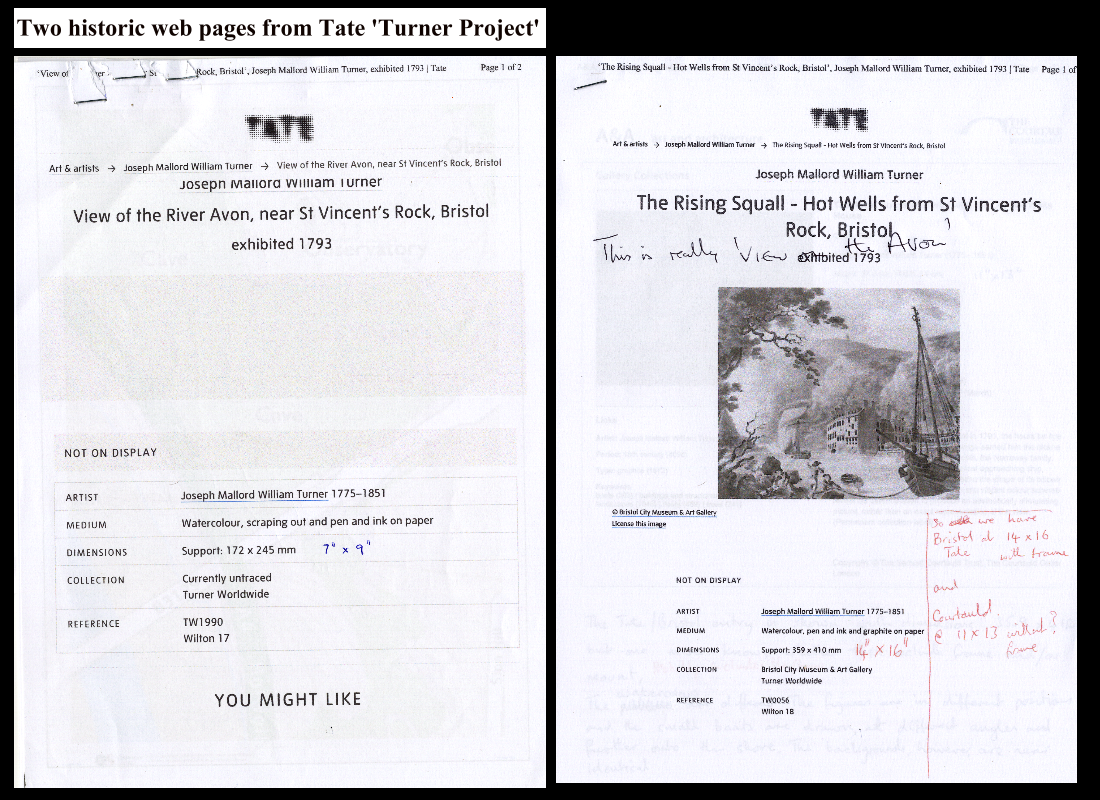
'The Rising Squall' and 'The Hotwells, Bristol, Lot 152'
February 2021
DRAFT
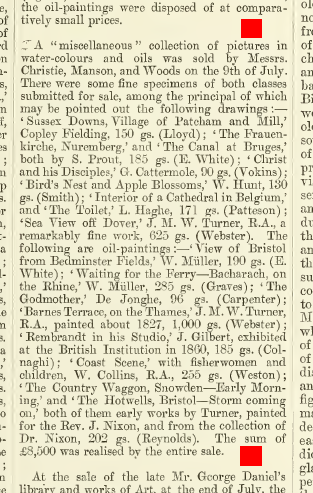
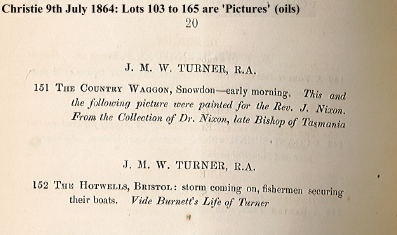
The description of lot 152 in this catalogue matches very well with our 'Squall at St Vincent's Rock, Bristol'. We identified the location in 'Squall at St Vincent's Rock, Bristol' by reference to Tate D00389 in theTurner Bequest. we therefore searched for sightings of Turner's 1793 exhibit, 'The rising squall, hot wells, from St. Vincent's rock, Bristol', for comparison to and identification of our picture. Lot 152 in this sale presented as a possible sighting.
In 1864 it would not have been possible to make an identification from the Turner Bequest because it was not organised and catalogued as it is today;
Some time after 1925 a curator at the Bristol Museum and Art Gallery identified Lot 152 in this catalogue as 'The rising squall, hot wells, St. Vincent's rock, Bristol' with 'Reynolds' as buyer.
Christie's records show that lots 151 and 152 were presented by a seller called 'Hogarth' and bought in. It is not clear who was responsible for the identification of lot 152 so here we refer to that person as the 'catalogue compiler'.
Our examination highlighted an inconsistency in that having identified lot 152 the catalogue compiler did not present the picture as 'The rising squall, hot wells, from St. Vincent's rock, Bristol (exh 1793)' but instead published a simple description. We further examined this inconsistency and concluded that lot 152 was most likely 'The rising squall, hot wells, from St. Vincent's rock, Bristol', the 1793 exhibit, but there is a small possibility that it could be 'Rochester Castle with Fishermen Drawing Boats Ashore In A Gale of Wind'.
Catalogue Information
The Catalogue Entries for Lots 151 and 152
Catalogue entries show the first owner as Rev. Nixon but make no mention of the Bishop's statement about 'Snowdon' being Turner's first oil.
Burnett's 'Life of Turner'
There was a collector named George R Burnett active around 1860 [asco 25390 1860-03-24] but no evidence that he wrote any books. However, he did collect works by JMW Turner and his sale is mentioned in Thornbury.
The British Library found no trace of 'Burnett's 'Life of Turner'' and offered the following explanation:

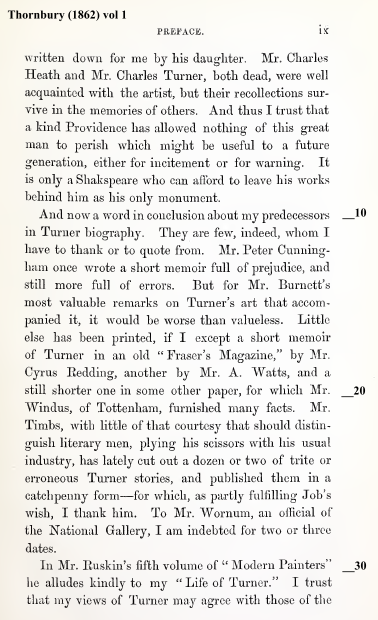
Thornbury (1862), vol 1, preface page ix, line 14, also mentions Cunningham and Burnet but spells Burnet with a double 't'.
Burnet 'Turner and His Works'
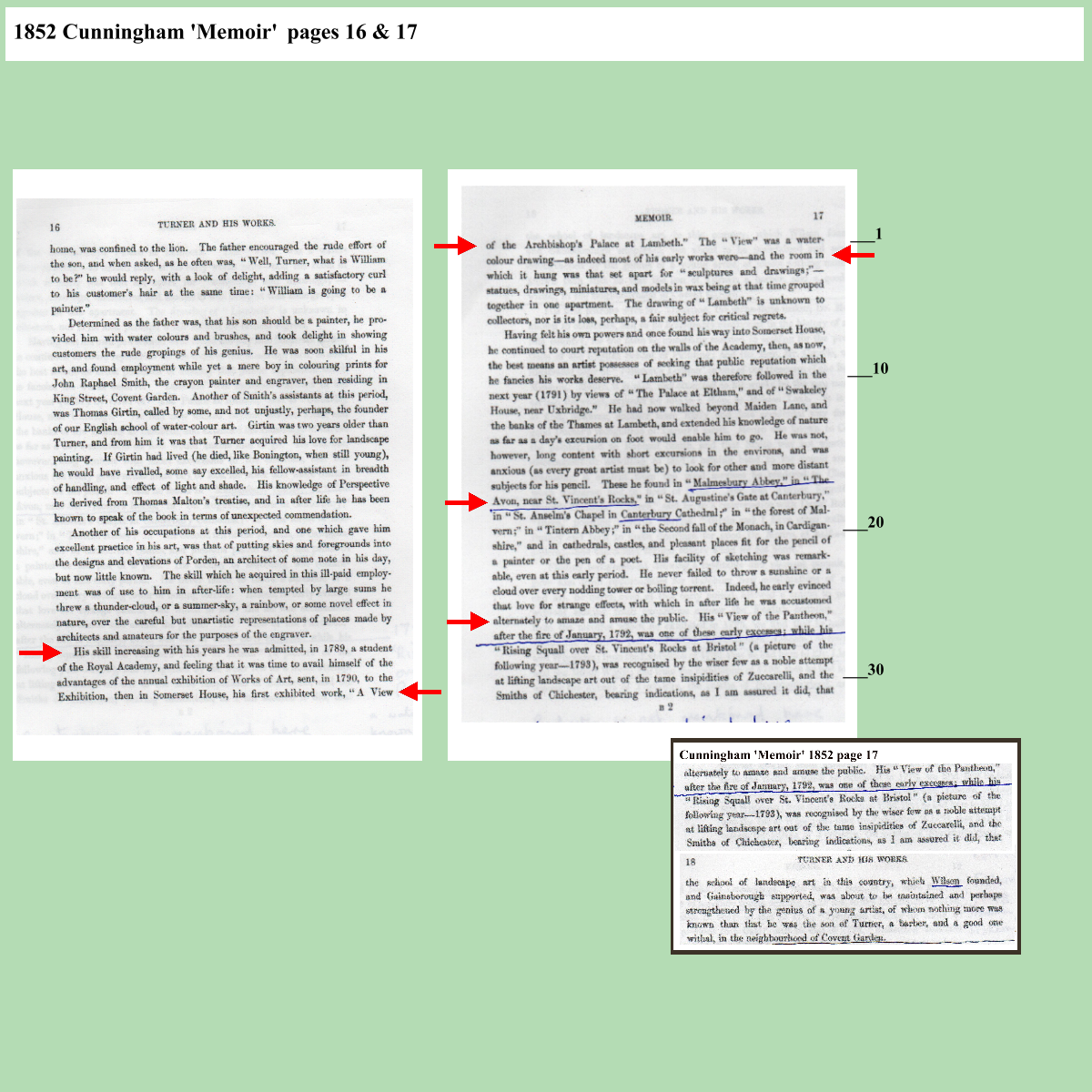
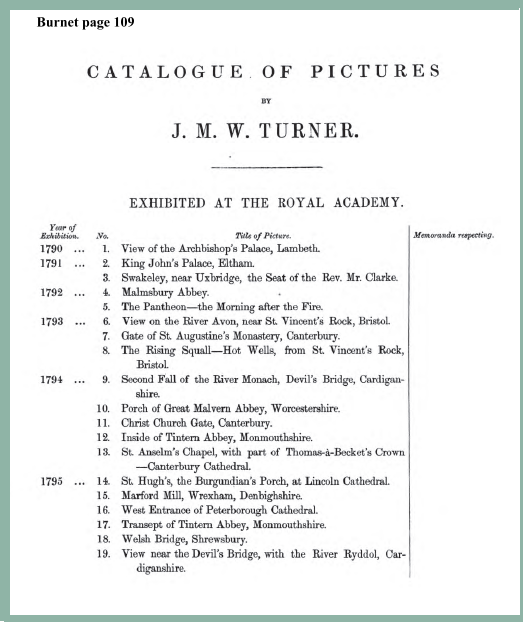
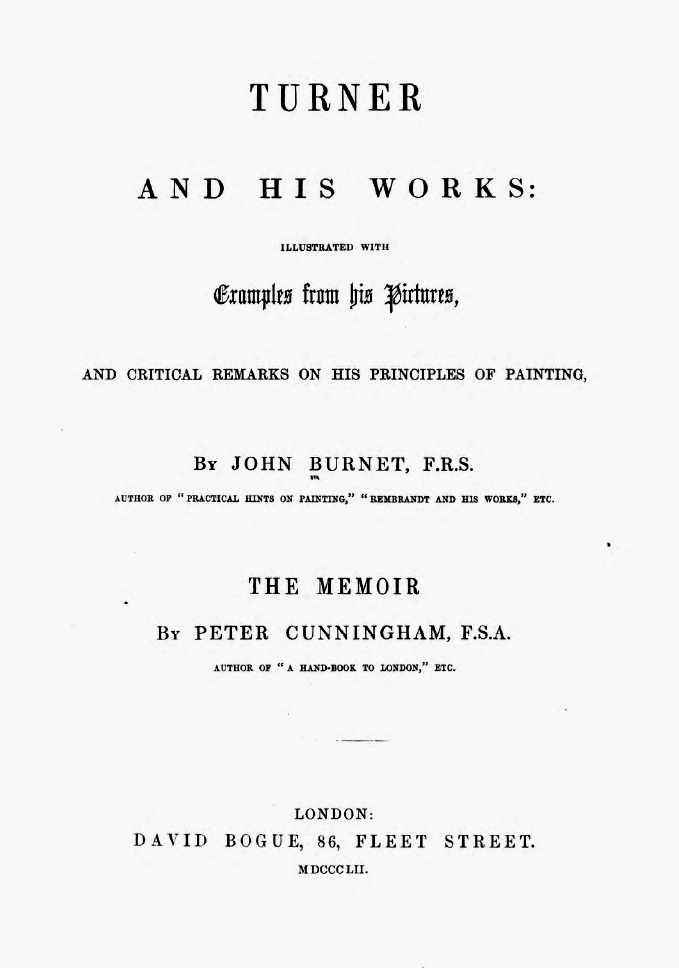
John Burnet 'Turner and his works' (1852) and its preface, 'Memoir' by Peter Cunningham contains two references that relate to the catalogue entry. In the 'Memoir' on page 17 and in a 'Catalogue of Works' on page 109. The reference on page 109 is the only mention of 'Hotwells' in the volume. The book was revised and reprinted in 1859 but both passages were identical.
The Art Journal 1864
The Art Journal reported the sale on page 267. The reported purchase by Reynolds is incorrect. The two pictures were bought in. However, this report does confirm that both pictures were "oil-paintings"
Christie's e-mail
Christies records show the seller as 'Hogarth'. Lots 151 and 152 were bought in and would have been returned to Hogarth.

Bristol Museum e-mail
Bristol Museum are in posession of a watercolour which was, from around
1925 (or slightly later) to about 1979, claimed to be 'The rising squall,
Hotwells, St. Vincent's rock, Bristol' (note the misquoted title). A
Tate Gallery online research page
actually repeated this claim (with Turner's original title) until 2019
when it was removed. (Our point here is not to discredit the
work of these two institutions; the Bristol Curator was quite likely to
have some information about the sale of his watercolour in 1864 but he
chose to examine the wrong sale: the Bristol Watercolour was probably the
one in the sale of 27th February 1864, the property of Leonard Huskinson
(aka 'Huskisson').)
The Bristol Curator, whilst mismatching the works, interpreted the
description in lot 152 as 'The rising squall, hot wells, from St.
Vincent's rock, Bristol'. This is our summary:
| Bristol Curator Title: | 'The rising squall, Hotwells, St. Vincent's rock, Bristol' | |
| Turner's Title: | 'The rising squall, hot wells, from St. Vincent's rock, Bristol' |
Note also that the Bristol Curator shows the buyer as 'Reynolds'. The Art Journal also shows the buyer as 'Reynolds'. Christie's records cannot be wrong; 'Reynolds' was probably the failed bid.
Delivery of the pictures to Christie's
The pictures were presented to Christie's by Joseph Hogarth who, on information from Bishop Nixon, could say,
Writing the Catalogue Entries
The catalogue compiler could immediately write 'This and the following picture were painted for [and his knowledge of Bishop Nixon's father being slightly incomplete gets the initial wrong - maybe confusing him with his brother, John] the Rev. J Nixon. [In the next sentence the compiler uses the word 'late' probably not to indicate 'decease' but just to say that Dr Nixon is no longer the de facto Bishop of Tasmania.] From the collection of Dr. Nixon, late Bishop of Tasmania.'
The compiler would have examined each of the pictures. This is 1864, there is no CF Bell, no Armstrong, no Redford, no Graves. It is unlikely, but not impossible, that he had access to the Turner Bequest (D00389). His reference books in date order were likely to be:
and he would have had access to the Christies archive of sales catalogues and ledgers up to 1864. He may have examined the archive and found no references to these pictures. We have no idea whether or not he examined Miller and Thornbury. He made no literary connection with 'View of Snowdon, North Wales'. However, according to his catalogue entry he examined Burnet in connection with Nixon's title, 'Landscape'.
Looking at 'View of Snowdon, North Wales' the compiler sees Snowdon, a cottage, a wagon and horses, waggoners and some cattle. The compiler finds a signature, 'W Turner'. He also sees lighting and colouring suggesting early morning. [We have only a monochrome photograph but even that does suggest early morning, there is diffuse light, no long or strong shadows and the top of the mountain is in a mist.] His title for the catalogue therefore seems reasonable and appropriate but abbreviated by putting only essentials in his title: 'The Country Waggon, Snowdon - early morning'
Next, looking at 'Landscape' the compiler sees: Storm, fishermen and Boats. If he had seen 'Hotwells' in the picture he could have written the title he gave without reference to Burnet. However, the compiler did refer to Burnet, "vide: Burnett's Life of Turner" (actually mis-spelling the author's name and misqoting the title - but nevertheless clearly stating his reference) which suggests that he did not see 'Hotwells' in the picture. From Burnet (and Cunningham) he is able to determine the location - 'Hotwells':
He is now able to complete his catalogue entry for 'Landscape', "The Hotwells, Bristol - storm coming on, fishermen securing their boats.". ( He clearly favours a descriptive entry rather than the title from Burnet's 'Catalogue of Pictures'.)
Uncertainties In the Identification of Landscape
Neither Burnet nor Cunningham used 'Picture' consistently to describe oils.
Why not just use the title given by Burnet?:
Possible Misidentification: mix-up with Rochester
This sale is the only link between 'The rising squall, hot wells, from St. Vincent's rock, Bristol' (1793)' and the Nixon Family. The catalogue entry (for lot 152) as it stands describes this picture and the curator at Bristol Museum (in or after 1925) thought so too.
However, from the above ('looking at 'Landscape'') we know that without knowing the location the complier would have written:
Within reason there are only two pictures, both known to be early oils, that lot 152 could be:
Just before the 1793 exhibition JMW Turner painted two 'Rochester' pictures whilst on a tour of Kent but literary sources either conflate or muddle them. A description of the first, painted for Rev. James Douglas is found in a letter written by a nephew of his daughter.[see: 'Rochester Castle and the Adjacent Grounds'] A description of the second, painted for the Rev. Robert Nixon at Foots Cray is found in Miller (Miller, confusingly, appears to present this as a description of Douglas's picture.) [see: Events Recorded by Miller]
Miller is talking about Douglas's picture but the fishing boats and gale of wind are not in Douglas's picture.
A resemblance to De Loutherbourg indicates storms, fishermen and boats.

Looking at Miller's description, as written, we would expect to see a representation of Rochester Castle (a familiar landmark); "The view is Rochester Castle". However, this description is printed in a footnote account from an unknown source. Turner had already painted a view of the Castle for Rev. James Douglas at Rochester. It is possible that Turner would paint another (view of the castle itself) from a different viewpoint. However, it is also possible that he painted a view from Rochester Castle for Rev. Robert Nixon; and the assertion that 'The view is Rochester castle' was merely inserted by Miller.
If the view was 'from' Rochester Castle the catalogue entry would be:
All that stands between these two different interpretations is that the catalogue compiler examined Burnet first and finding a likely picture did not go on and examine Miller.
Bishop Nixon's Claim to Turner's 'First' Oil
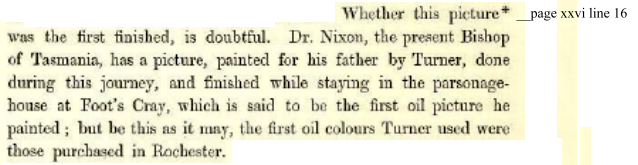
Bishop Nixon's collection is well documented and he had five JMW Turners, two of which were oils and three were watercolour-drawings.[Bishop Nixon's five Turners]. Hobart Town Exhibition catalogues and press reports make it clear that the Bishop regarded his 'View of Snowdon, North Wales' as Turner's first oil. That is the picture that Miller refer's to in this paragraph. However, we have not found any reference in Nixon's claim that coincides with Miller's 'done in this journey'. It seems more likely that the Bishop had hearsay that one of his pictures was 'Turner's first oil' when, more accurately, the Bishop had been given 'Turner's first exhibited oil'.
Procedure Consequent on this Doubt
This section is intended to draw attention to a possible doubt in the construal of catalogue entry for lot 152 and the need to explore other routes by which 'The rising squall, hot wells, from St. Vincent's rock, Bristol' may have left the academy after the exhibition. If photographs of Bishop Nixon's collection are found, and if 'Landscape' is amongst them, then this issue will be resolved. These notes are therefore paused awaiting the photographs.
MORE TO DO BELOW
Our 'Squall At St. Vincent's Rock, Bristol' is definitely Hotwells from D00389 and D00074. If 'Landscape' turns out to be Rochester then ours was never in the Nixon collection.
'Rochester Castle with Fishermen Drawing Boats Ashore In A Gale of Wind' has not been located. We have examined our 'Squall At St. Vincent's Rock, Bristol' with a view of determining whether Turner took Nixon's 'Rochester' picture back to London and remade it as 'St. Vincent's Rock' by painting the rock-complex on it (and on D00384). If Turner had sufficient canvas for four pictures at this time (late 1792) in this scenario one piece would remain and there would be another 1792 picture.