ROCK-COMPLEX EVIDENCE~O~
The discovery of JMW Turner's oil on canvas exhibited at the Royal
Academy in 1793 ~O~
ROCK-COMPLEX EVIDENCE
START OF PRESENTATION
St. Vincent's Rock, Hotwells, Bristol -
Rock-Complex Evidence
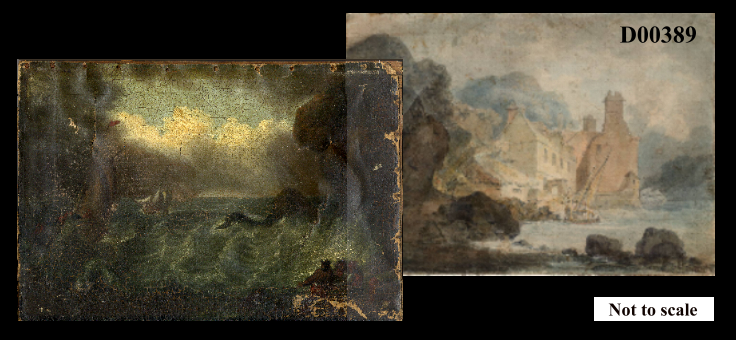
The oil picture is herein referred to as 'The St. Vincent's Rock Oil':
By visual comparison with JMW Turner's watercolour-drawing 'Back View of the Hot Wells, Bristol'*[1], D00389, at Tate Britain being part of the Turner Bequest, the rock-complex motif thereon consisting of an overhanging rock and a dome rock in close proximity in a view towards the riverbank is repeated on 'The St. Vincent's Rock Oil' in the opposite direction to form a view from the riverbank looking out towards the river.
[_NEXT_]
02_00
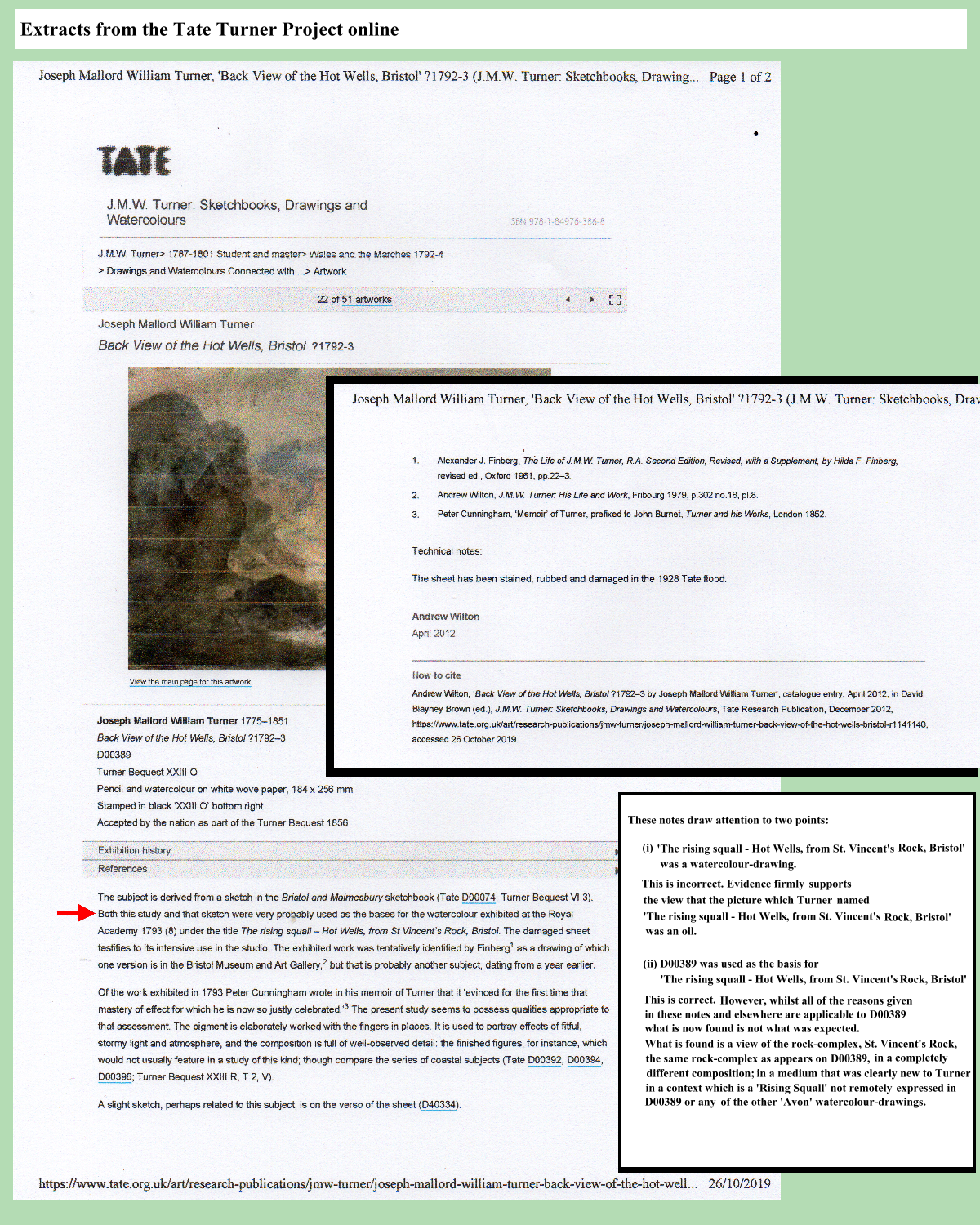
Footnote *[1] 'Back View of the Hot Wells, Bristol', D00389, at Tate Britain.
Footnote *[2] 'Once A Week' 1862
This extract from 'Once A Week'
magazine suggests that Turner kept his sketches and unfinished work
private.
Possible loan to 'a pupil' is considered below*[8].
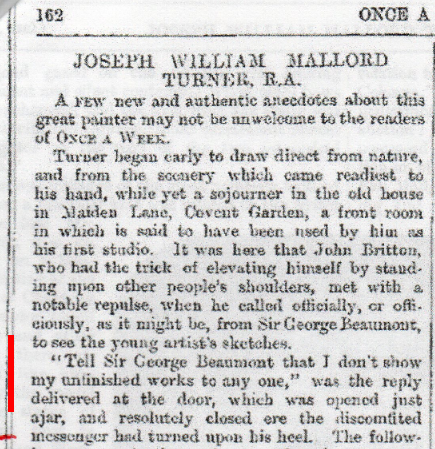 'Archer' writing in 'Once A Week' 1 February 1862.
Footnote *[3] There is No Evidence That Turner's Rock-Complex Existed
The reversal of the rock complex in the oil so closely matches Turner's
painting of it in D00389 that it is unlikely that there could be any other
primary source for what is seen on the oil other than the rocks themselves
if they actually existed which they probably did not.
The rocks are not there now; of the original Hotwells buildings only the Colonnade survives, the notional site of the rock complex being on the route of the A4 (Google Earth search 'Clifton suspension bridge' and navigate southwards - the curved building (the Colonnade) is clearly visible as it is in the photograph below.
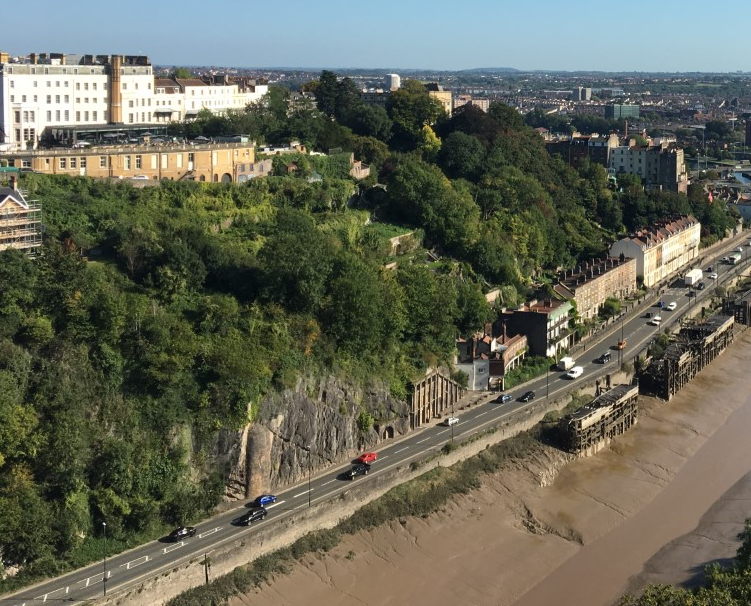
Footnote *[3] continued.
Historic images of Hotwells and St. Vincent's Rocks show no rock structures sufficiently similar to Turner's rock-complex to suggest that another artist could have painted the oil using the rocks themselves as a primary source. In one of Ibbetson's images below there is a rock resembling the dome rock and an artist sketching it! The dome rock alone appears in another Turner watercolour-drawing, D00391.
The building of the Clifton suspension bridge commenced in 1831 and many of the nearby rock structures were destroyed.
P Nasmyth [b.1786 d.1831]
Nasmyth appears to have produced oils of landscapes around Bristol
and other places notably Epping. Recorded sizes are small (around 18"
x 24") but only few examples have been found at the time of writing
(November 2019) and not St. Vincent's Rock.
There is a sale of 'St. Vincent's Rocks, Clifton' by Nasmyth in
Redford Vol II page 88. Sale 1860, 141 guineas, seller N.N, buyer Wallis.
No date is given for the painting of this picture and no image is
available.
Footnote *[3] continued.
Published 1793 these 1792 scenes show St. Vincent's Rock in a less
dramatic form:
Turner worked with Ibbetson but it appears later
than this 1793 edition.(see comments from bohn catalogue p93 - shown
below)
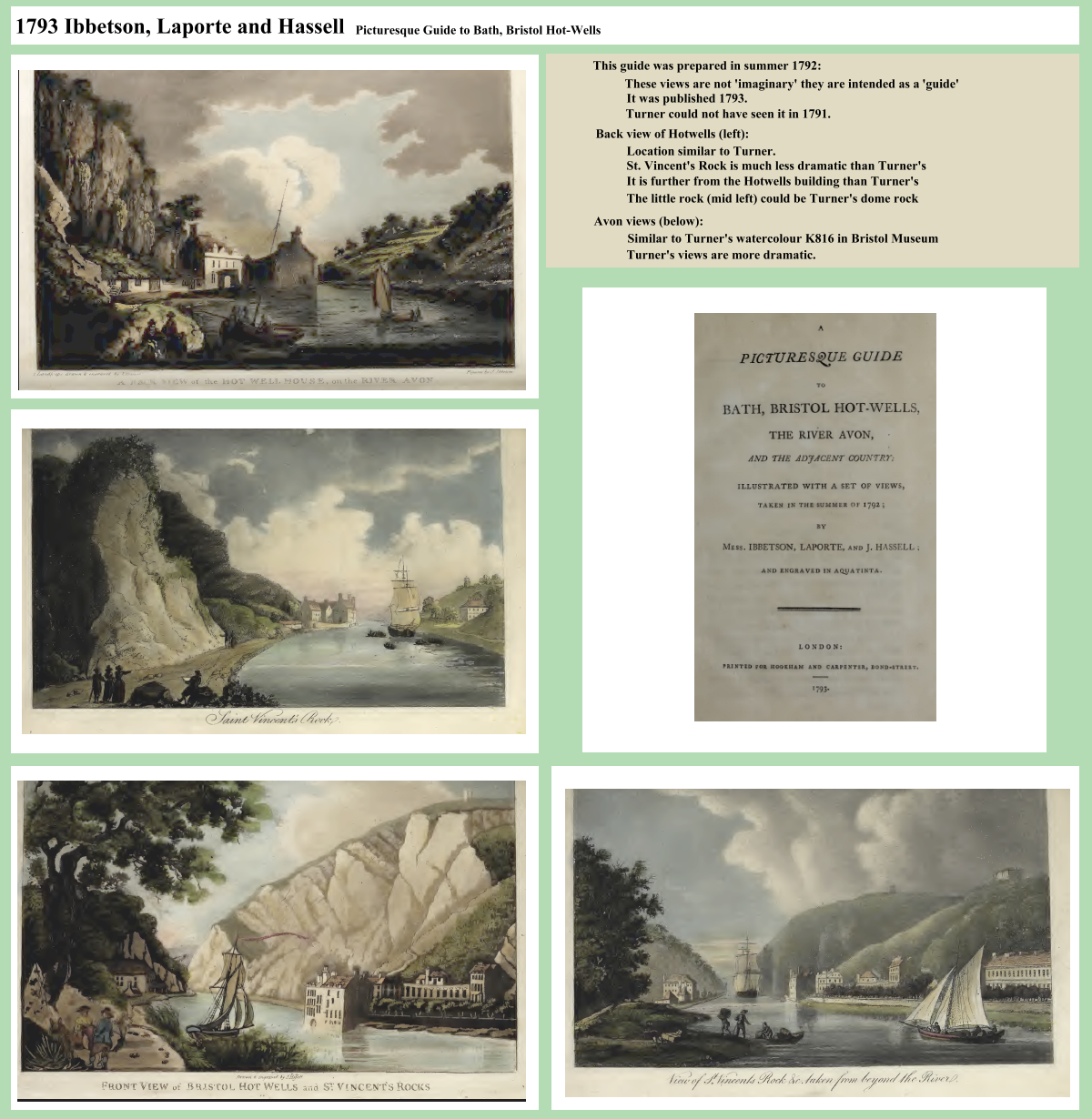
Footnote *[3] continued
Turner worked with Ibbetson.(bohn catalogue p93) but probably later than 1793.
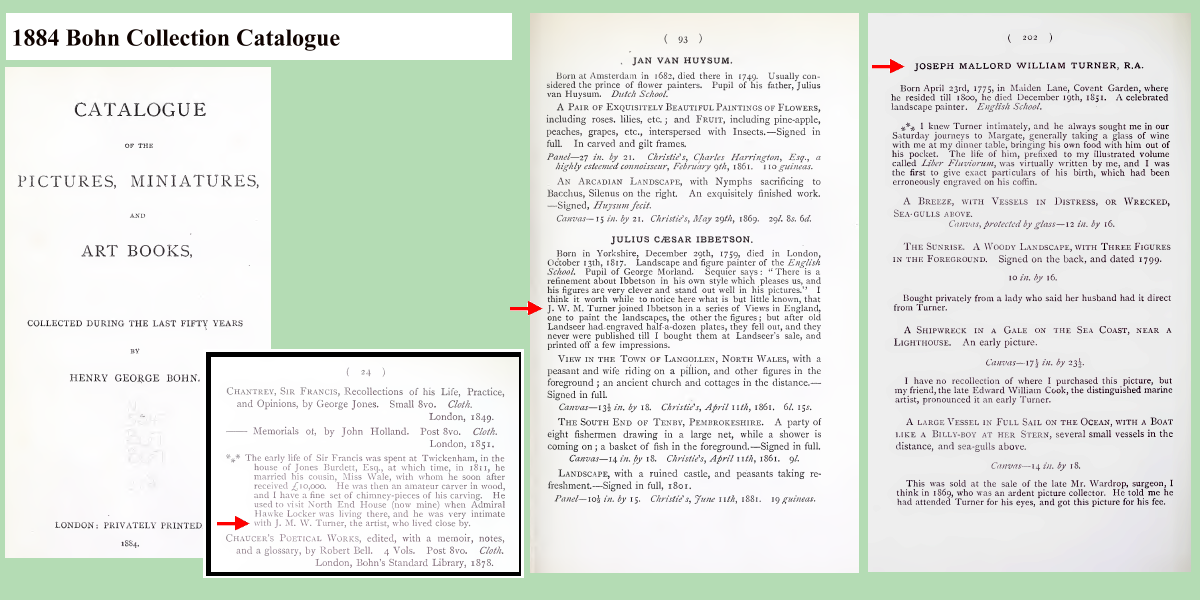
Footnote *[3] continued.
Turner's St. Vincents Rock rock-complex (overhanging rock and dome rock)
appears in his watercolour 'Back View of the Hot Wells, Bristol', D00389.
The dome rock and its projection (but not the overhanging rock)
appear in Turner's watercolour D00391, 'Landscape Composition with a
ruined Castle on a Cliff'.
Sketches for these date from 1791.
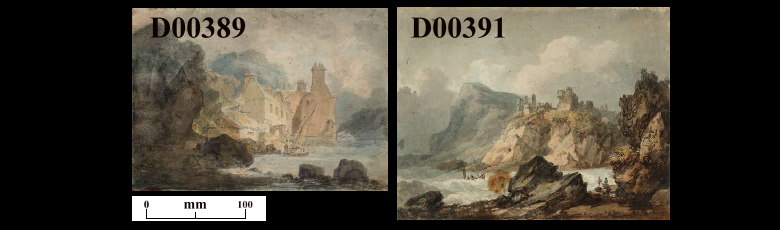
In D00389 the view is from the river towards the riverbank. The dome
rock is reversed in D00391 and the oil (green arrows)
creating a view from the riverbank towards the river.
Views of the dome and its projection (red dots)
indicate that the view point of the oil is off the right hand side of
D00391.
It is possible that the cliffs on the right of D00391 are another
aspect of the overhanging rock.
The little hump on top of the dome is clearer on the canvas than in
the scans shown here.

Footnote *[3] continued.
In an image said to be 1754 where there is no indication of Turner's rock-complex.
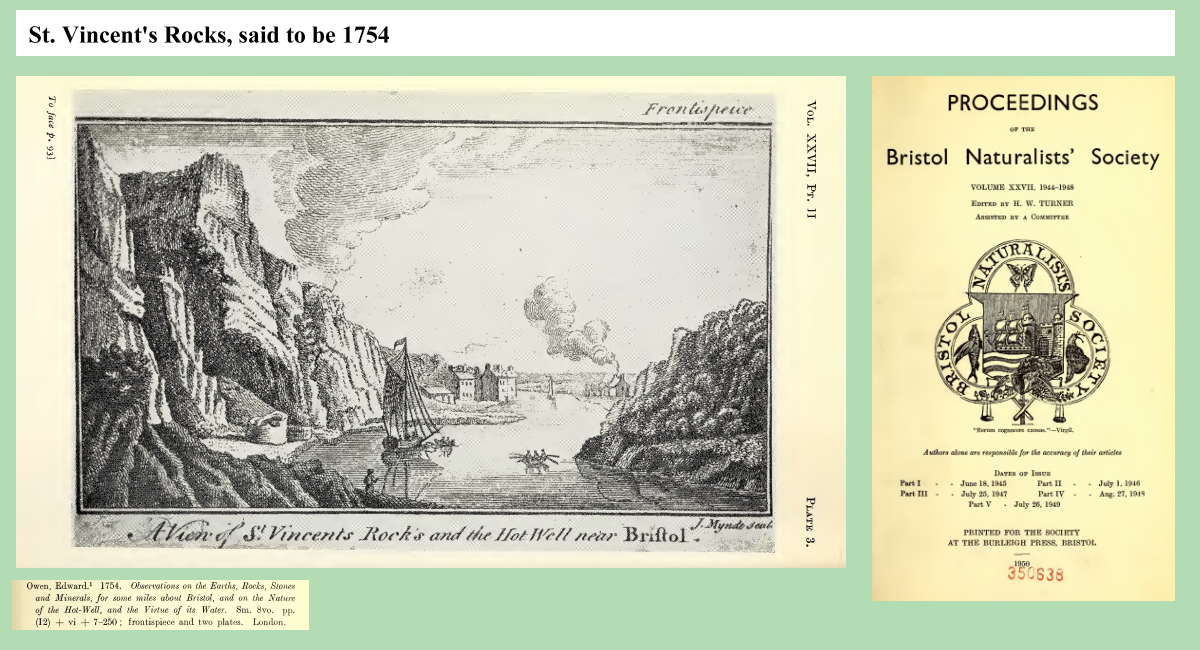
Footnotes, cont...
*[4] Interpretation of the relationship between 'The St. Vincent's Rock Oil' and Turner's watercolour, 'Back View of the Hot Wells, Bristol', D00389.
It has been shown that Turner exhibited an oil named 'The rising squall, hot wells, from St. Vincent's rock, Bristol' at the 1793 RA Exhibition (page ref. 07_00 et seq.). Logically it is assumed that the D00389 (c.1791) pre-dated the oil. A counter argument that Turner copied the St. Vincent's Rock rock-complex from the oil has to be considered. Researchers have dated D00389 before 1793. If Turner had copied from the pre-existing candidate oil onto D00389 he would then have to paint his oil for the exhibition. The latter argument introduces another artist and Turner's aquisition of the oil (or borrowing of it) before or shortly after his visit to the Narraways in 1791 at age 16. For certain The St. Vincent's Rock Oil and D00389 were in Turner's studio together. The St. Vincent's Rock Oil meets all the descriptive criteria to be 'The rising squall, hot wells, from St. Vincent's rock, Bristol' and the prosaic explanation is simply that Turner saw his little watercolour D00389 as his source of inspiration (together with his recent painting at Foots Cray - 'Rochester Castle with Fishermen Drawing Boats Ashore In A Gale of Wind' (inf. page ref: 20_10) - for his oil for the 1793 exhibition).
Another scenario to be considered is that 'Back View of the Hot Wells, Bristol', D00389, was initially drawn and painted without the rock-complex and that it was added at the time the oil was painted.
Footnotes, cont...
*[5] Opposite and Multiple Views are a common feature of Turner's work before 1793.
B+M Fo 12R View of the ruins of malmsbury abbey
from the south-east D00086
B+M Fo 22R Malmsbury abbey from the north-west D00105
OxS Fo 06R View of Nuneham Courtenay near
Abingdon from the South-West 1789 D00016
OxS Fo 15R Nuneham Courtenay The East Front 1789 D00029
OxS Fo 10R View of Nuneham Courtenay from the Thames with a Barge
1789 D00022
Watercolour 07 Radley Hall from the North-West
1789 D00048
Watercolour 08 Radley Hall from the South-East 1789 D00049
Footnotes, cont...
*[6] The Rock-Complex Motif in Other Turner Paintings
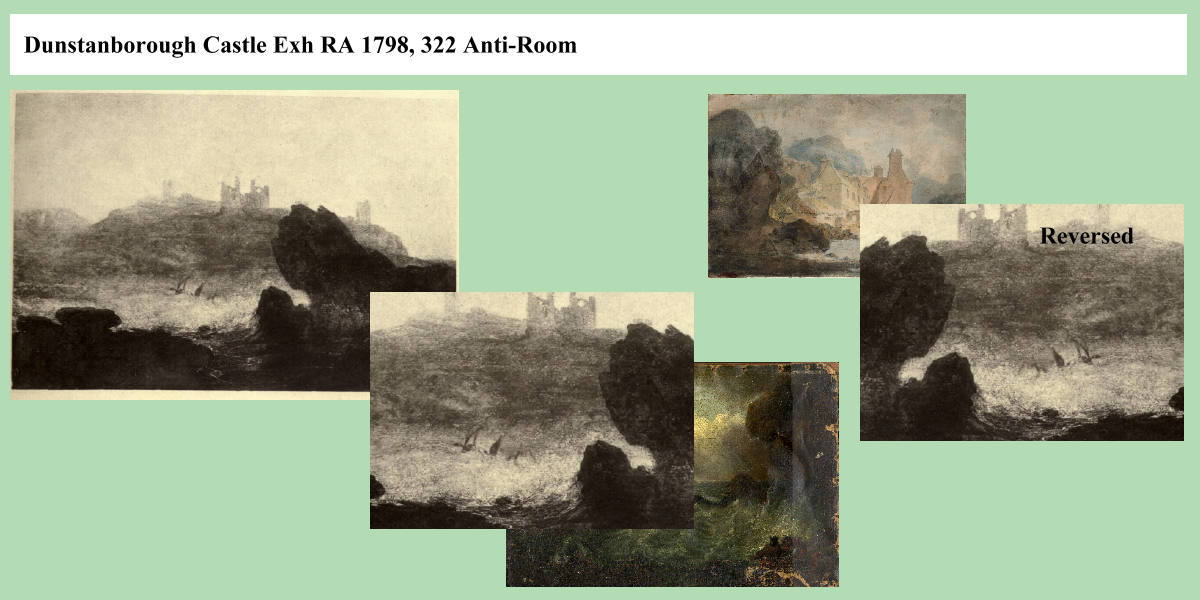
Turner appears to have repeated the St. Vincent's Rock rock-complex motif in his 1798 exhibit ' Dunstanburgh Castle, N.E. Coast of Northumberland, Sun-rise After A Squally Night' [NGM, Size: 36" x 49"]. The overhanging rock is slightly modified but the top of the dome rock is very similar and it is possible to see, in the reversed image, that the spatial relationship between the two rocks is maintained from D00389 (but as if a mirror image). There are many versions of 'Dunstanborough Castle' some with the rock-complex and some without. The illustrated version below is from Armstrong and is said to be the 1798 exhibit.
Footnotes, cont...
*[7] 'Back View of the Hot Wells, Bristol', D000389 - Both Sides
This watercolour is close in size to pages in 'The Bristol and Malmesbury Sketchbook' but is probably not the page known to have been removed from it (at Fo.18).
Watercolour 'Back View of the Hot Wells, Bristol', D000389, 184x256mm painted after (or possibly during) Turners visit to his father's friends, the Narraways, in Bristol in 1791 appears to have been slightly trimmed. Pages in 'The Bristol and Malmesbury Sketchbook' are 185x263mm and one torn-out page left a stub 10 to 17mm wide which would make the torn-out page less than 253mm wide. The watercolour appears to be slightly too big to be a page from 'The Bristol and Malmesbury Sketchbook'.
On the left is the image of the verso as supplied by Tate D40334. To the right that image has been reversed (horizontally) and the recto D00389 overlaid to show alignment with the verso.
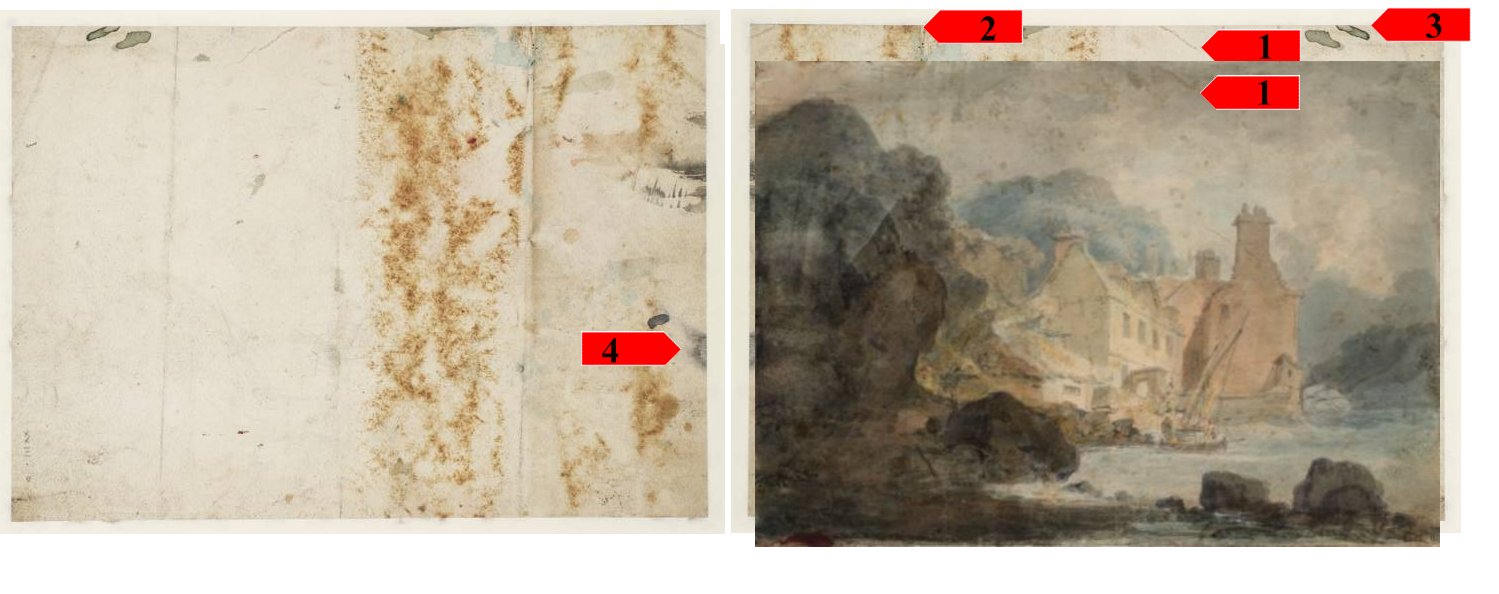
The orientation can be determined by marker 1 a distinctive stain or fold which appears on both sides of the paper.
The images were supplied at different resolutions. Marker 1 can also be used to determine alignment. The recto image was then resized to align the stain at marker 2. Slight misalignment shows that the recto image has been cropped slightly.
The presentation of the verso, laid out on a slightly larger cream coloured background, suggests that the entire sheet, as it now stands, has been photographed. If so the stain at marker 3 is 'impossible'; that is, to produce this stain the paper had to be larger. Other edge stains also appear to be 'cut off'.
It is not unreasonable to suppose that the sheet has been trimmed and looking at the marker 3 stain a minimum of 5mm appears to be a good approximation. It cannot be assumed that it would be trimmed 5mm all round; that figure can be said of only the top of the sheet. Marker 4 shows another stain that has probably been clipped by a few mm.
The stated size of the sheet now is 184 x 256mm.
The stated size of folios in the Bristol and Malmesbury Sketchbook is 185 x 263. The 'narrow stub' at Fo.18 is about 10 to17mm. So the torn out page width is between 246 and 253mm.
Given that D40334/D00389 has probably been trimmed to its current size, whilst being close to the size of the torn out page in the Bristol and Malmesbury Sketchbook, it appears to be slightly too big to be the missing page. It is, however, close to the paper size that Turner had in his sketchbook at the Narraways
D40334/D00389 and the stub are both white wove paper without watermark. Watermarks appear elsewhere in the sketchbook (the watermark on Fo.12 is 'J WHATMAN').
Footnotes, cont...
*[8] D00391, 'Landscape Composition with a ruined Castle on a Cliff' - Both Sides
The verso of D00391 is D40052 and is inscribed by Turner with his signature.
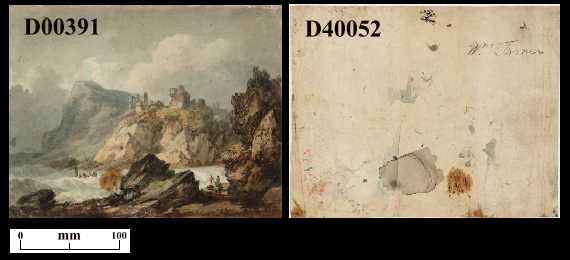
The signature is described as 'inscribed with brush and watercolour'. The presence of a signature is explained as 'lent to a pupil for copying'. The date is 'dating as it must from around 1792-93'. Turner was only 17, this all leaves a lot unexplained. However, the dome rock is clearly a central feature in the composition and is clearly seen form the opposite direction to D00389. A loan of this watercolour, D00391/D40052, would not be sufficient for a hypothetical pupil to recreate the rock complex. The absence of a signature on D00389/D40334 indicates that the watercolour, D00389, with the complete rock complex was not lent. (D00391 may have been the subject of a much later loan and the signature added at a much later date long after the oil was painted and exhibited in 1793.)
Paper is white wove watermarked 'J WHATMAN'. (like Fo.12)
At 214 x 273mm it is a little larger than D00389.
Footnotes, cont...
*[9] Turner's Views of the Rock Complex in D00389 and 'The St. Vincent's Rock Oil'
The St. Vincent's Rock complex consists of an overhanging rock and a dome rock with a little hump on top. (This footnote does not examine the dome rock projection which is visible only from the riverbank side. [see *[3] - 'Hotwells 1791' above].)
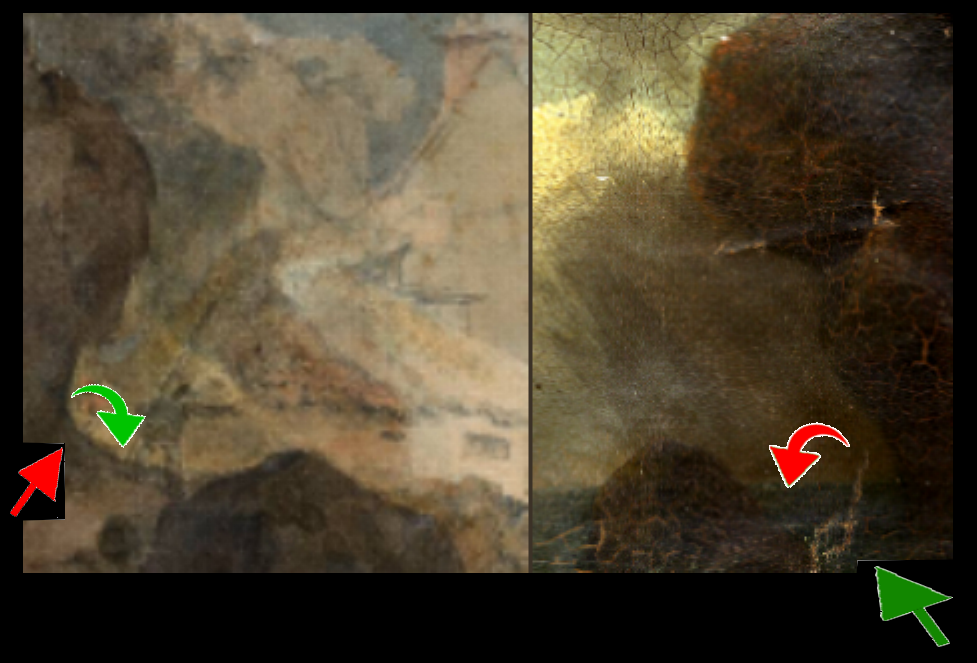
In the watercolour (left) the hump on the dome rock is slightly to the right of centre and on The St. Vincent's Rock Oil' (reversed) it is slightly to the left. The little hump on 'The St. Vincent's Rock Oil' shows better on the canvas than on the scanned image reproduced here. Red arrows show the direction of observation for the watercolour; green arrows show the direction of observation for The St. Vincent's Rock Oil'. The tide is lower in the watercolour than The St. Vincent's Rock Oil' (The River Avon has a great tidal range: www.severn-boating.co.uk.)
02_00