
JMW Turner's Two 'St. Vincent's Rock' Exhibits of 1793
Chapter IV: Loss and Misidentification of 'The Rising Squall' and 'View on the River Avon: Identity of the Two 1793 'St. Vincent's Rock' Titles
JMW Turner's Two 'St. Vincent's Rock' Exhibits of 1793
Chapter IV: Loss and Misidentification of 'The
Rising Squall' and 'View on the River Avon: Identity of the Two 1793 'St.
Vincent's Rock' Titles
Loss and Misidentification of 'The Rising Squall'
and 'View on the River Avon
How mistakes obliterated the identity of 'The Rising Squall'
Identity of the Two 1793 'St. Vincent's Rock' Titles
2. Late 1870's to mid 1880's
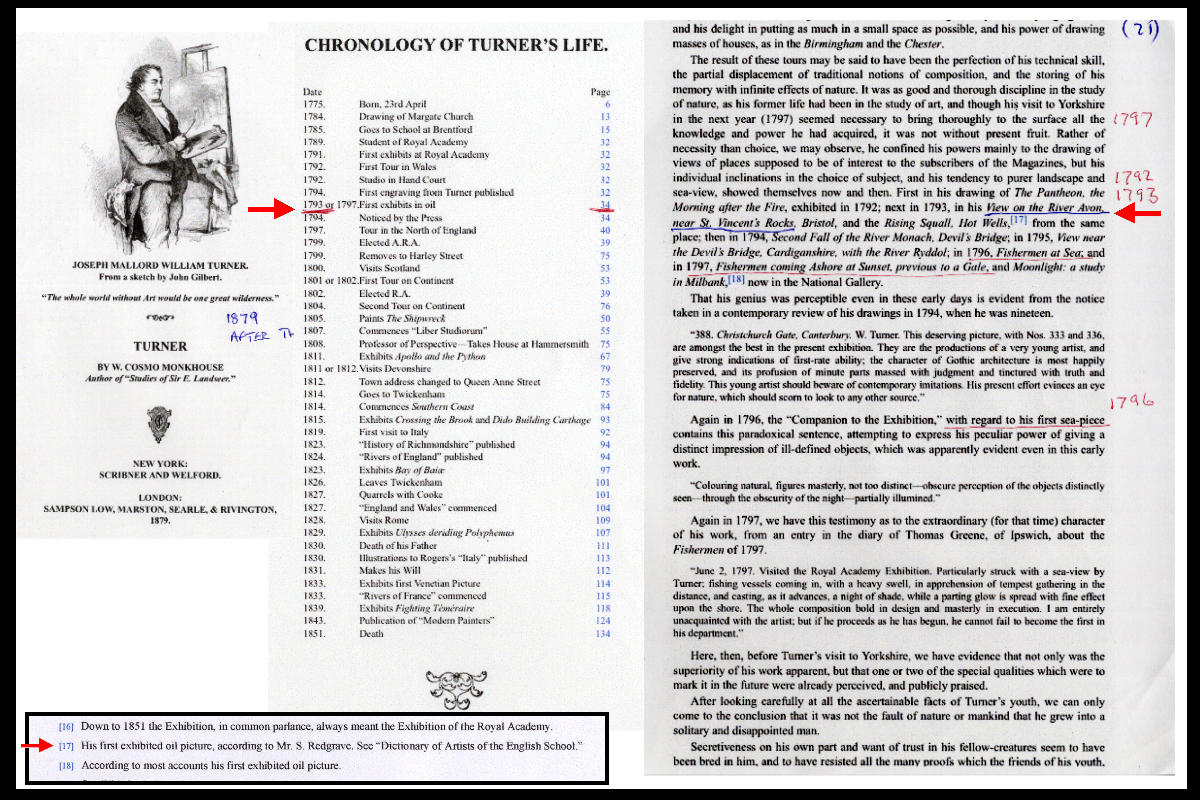
Cosmo Monkhouse 'Turner' 1879
discusses both titles briefly. He does not arrive at his own conclusion
about 'The Rising Squall' but just puts two opposing views in footnotes
[17] & [18]. He clearly sees 'View on the river Avon, near St.
Vincent's rock, Bristol' as a watercolour-drawing.
His comments introduce uncertainty
In respect of 'Moonlight', Monkhouse wrote, "According to most
accounts his first exhibited oil picture"
His concept of 'most accounts' seem to reflect the muddled accounts
of Thornbury.
However, all of these comments must be viewed against the backdrop of transposed titles in the 1793 RA exhibition catalogue. The applied logic (ignoring the transposition) would be that 'View on the river Avon, near St. Vincent's rock, Bristol' had been seen at auction on 27th April 1864 and was most definitely a watercolour-drawing. Therefore (wrongly) this watercolour-drawing appeared in the Anti-Room in 1793.
The real logic is that 'View on the river Avon, near St. Vincent's rock, Bristol', seen at auction on 27th April 1864, was most definitely a watercolour-drawing and that, given prevailing practice of separating watercolours from oils, it could not possibly have been hung in the Anti-Room in 1793; therefore the titles were transposed in the catalogue. (We also have Edward Bell's marked up catalogue to support this: he marked up only 5 as non-oils and these were marked 'crayons'/'drawings' and 4 are known to be pastils of outstanding quality with the fifth being a possible slip-up.) This logical argument continues because something by Turner was hung in the Anti-Room and the only possible candidate is 'The Rising Squall' which was seen at auction on 9th July 1864 and which was an oil.
Art historians chose to 'believe' the former and C.F. Bell and others gave elaborate inaccurate explanations* to promote the view that JMW Turner's Anti-Room exhibit was a watercolour. This led to a belief that 'The rising squall, hot wells, from St. Vincent's rock, Bristol' appeared in the Library and, because the Library held watercolours, the belief that 'The Rising Squall' was a watercolour. There is, however, a caveat to this. Whilst we have found no evidence of watercolours in the anti-room we have found some evidence of oils hanging in the library - this work is ongoing.
By the late 1870's to mid 1880's,
* C.F. Bell was discussed in Chapter III and the consequences of his mistake are discussed at item 4 below