
'The rising squall, hot wells, from St. Vincent's
rock, Bristol'
by JMW Turner; exhibited at the Royal Academy in 1793
Analysis of the full Text of Cunningham's 1793 Commentary:
His reference to The Pantheon
Turner's 'The Pantheon, the morning after the fire' was painted after the fire of 14th January 1792 and exhibited at the 1792 RA Exhibition No. 472 in the Antique Room. Its size: 15" x 20" (roughly the same as the original size of 'Squall at St. Vincent's Rock, Bristol', the oil on canvas discovered August 2018).
Turner's only other exhibit in 1792 was 'Malmesbury Abbey' No. 436, also in the Antique Room. Malmesbury Abbey was painted from sketches made the previous year (1791) in the Bristol and Malmesbury Sketchbook. This exhibit must have been completed or near completion in January 1792 when the fire destroyed the Pantheon because clearly Turner stopped working on his planned exhibits and instead went out to sketch the ruined Pantheon and then went on to paint the finished Pantheon exhibit in time to have it accepted for exhibition that year. It is noted that at this time there were no other Bristol and Malmesbury exhibits ready for the 1792 exhibition. (In David Solkin's 'Art on the Line' there are references which indicate that the process of submitting works for exhibition was time consuming. The art work had to be finished and dry of course; it had to be mounted in a gilt frame which, for watercolours, would involve glazing; then there was the secretive practise whereby exhibits were allocated their exhibition rooms and numbers.)
'The Pantheon, the morning after the fire' was part of the Turner Bequest and there is no doubt that it is a watercolour (Tate: "Graphite and Watercolour on Paper").
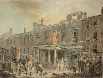 'The Pantheon, the morning after the fire' 1792 No. 472, Tate D00121,
watercolour drawing 15" x 20"
'The Pantheon, the morning after the fire' 1792 No. 472, Tate D00121,
watercolour drawing 15" x 20"
When Cunningham refers to this work its title is slightly different:
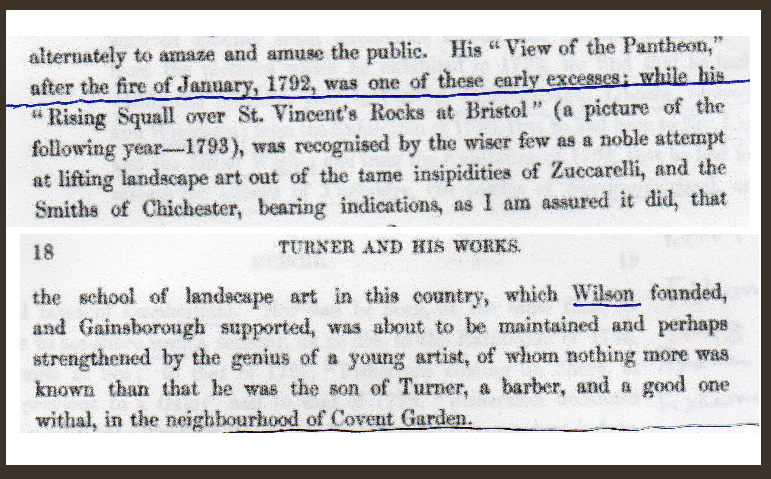 Cunningham
calls it 'View of the Pantheon'
Cunningham
calls it 'View of the Pantheon'
Turner's original title can be seen in the catalogue:
Watercolours and oils were not mixed, they were exhibited in different rooms. Exhibits in the Antique Room (in 1792) were watercolours.
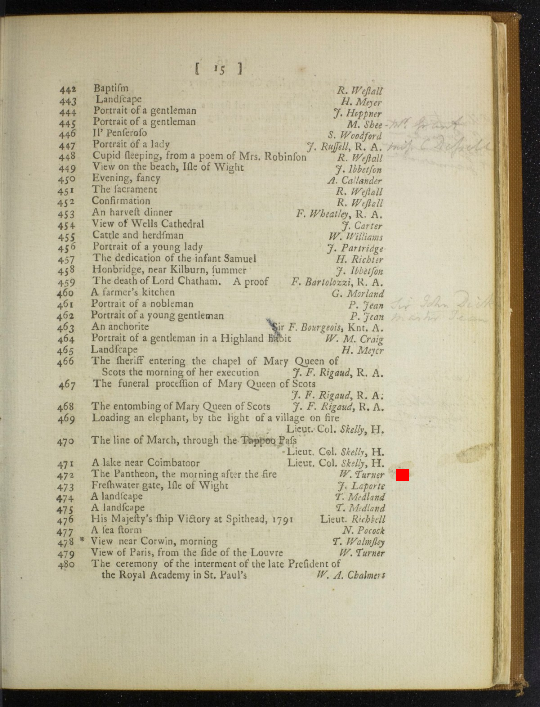 1792 Exhibition Catalogue page 15. Royal Academy