SPECIFIC IDENTIFICATIONS
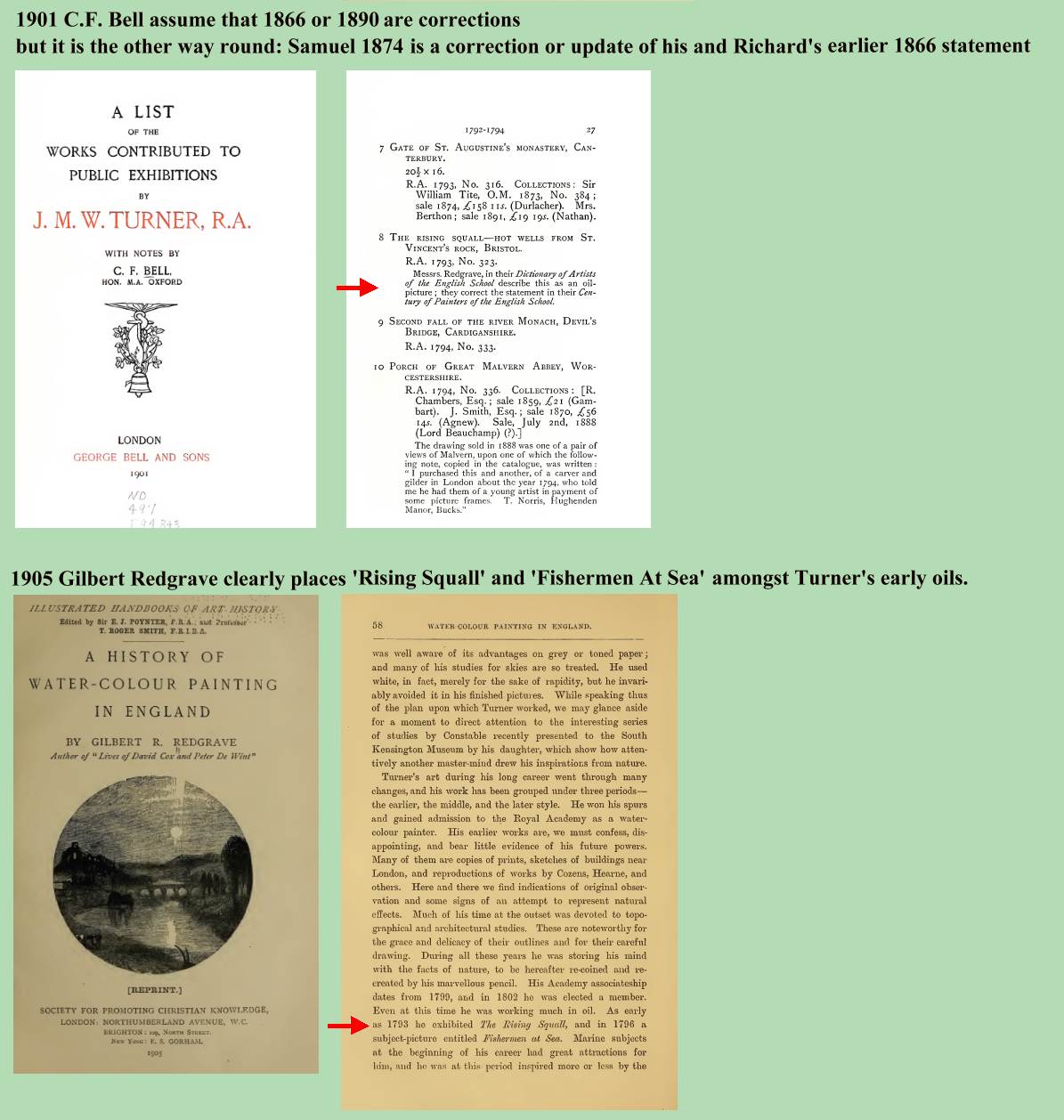
CF BELL - 'A LIST OF THE WORKS CONTRIBUTED TO PUBLIC EXHIBITIONS BY JMW TURNER RA'
BELL'S ERROR IN RESPECT OF THE WORKS OF RICHARD, SAMUEL & GILBERT
REDGRAVE
ON THE IDENTITY OF JMW TURNER'S FIRST EXHIBITED OIL
In 1901 CF Bell compiled 'A List of the Works Contributed to Public Exhibitions by JMW Turner RA'. The list itself is an extract of Turner's works from Royal Academy Exhibition catalogues. It has been used as a reference work and its influence in modern research an documentation is self evident. Problems arise not from the list itself but from C.F.Bell's interpretations and opinions which are poorly researched and in many cases quite simply wrong. see: C.F.Bell - A catalogue of errors.
'The Redgrave Sequence'
Samuel, Richard and Gilbert Redgrave and CF Bell Sequence 1866 to
1905
This sequence of publications led to a widely held but mistaken belief that 'Moonlight' was Turner' first exhibited oil. CF Bell was entirely responsible for ths mistake. This study shows that the Redgraves finally endorsed the view that Turner's first oil exhibit at the Royal Academy was 'The Rising Squall' in 1793.
Section 1. The original Publications:
Section 2. The Revised Editions:
Section 3: The CF Bell Misinterpretation and The Final Gilbert Redgrave Record
This sequence ends with Gilbert Redgrave's statement:
The Redgrave Sequence
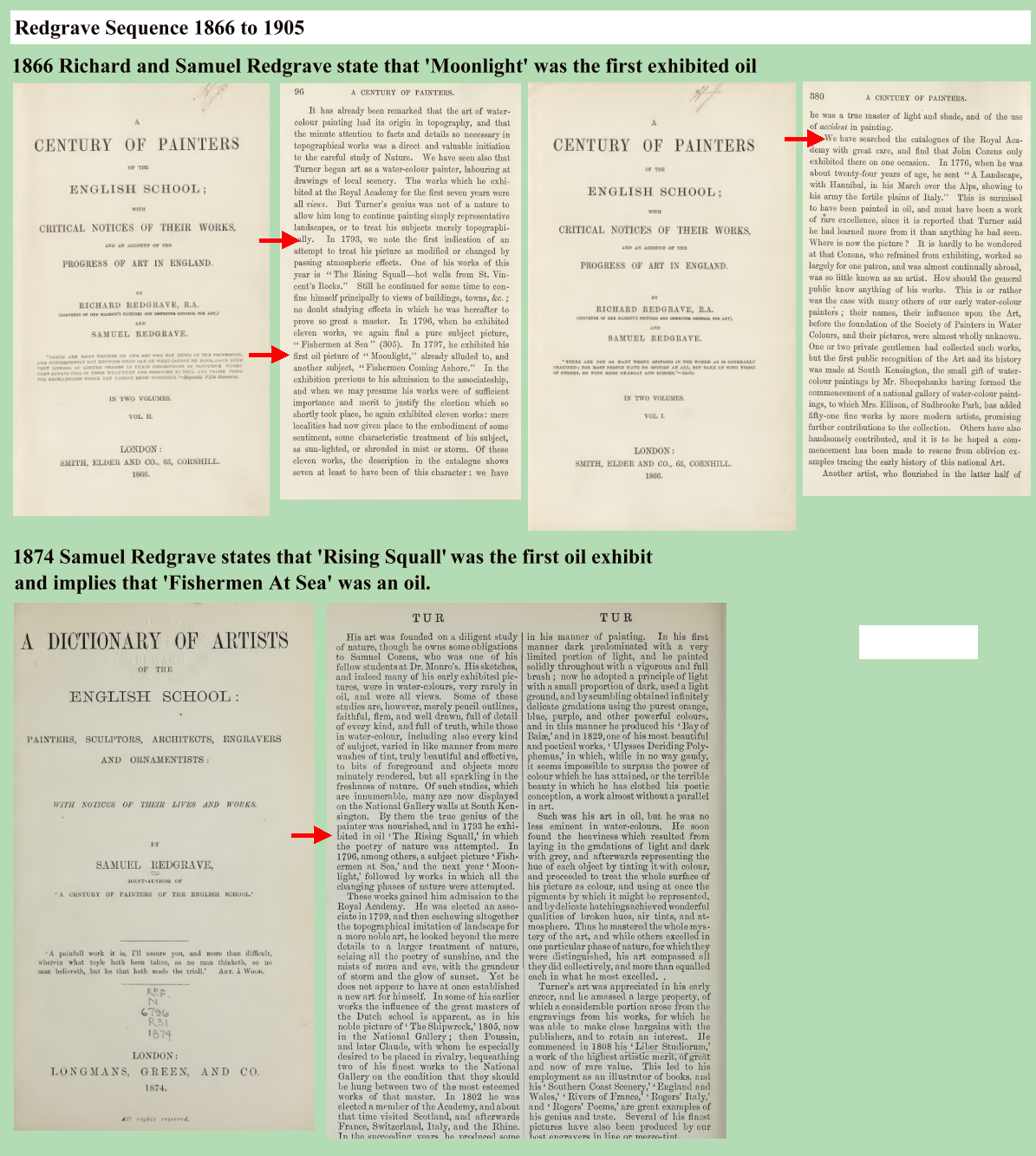
In 1866 brothers Richard and Samuel Redgrave published 'A Century of
Painters of the English School'. In the 'John Cozens' section they wrote,
"We have searched the catalogues of the Royal Academy with great care"
[page 380]. On page 90, writing an account of Turner's exhibits, they
quote the title, "The Rising Squall - hot wells from St. Vincent's
Rocks". This title must have originated from the catalogue but
differs in two aspects. The first is 'Rocks'[ plural ] instead of Turner's
'Rock'[ singular; the second is that the Redgraves omitted the final
'Bristol'. Having access to the RA catalogues would have suggested
(wrongly) that 'The Rising Squall - Hot Wells from St. Vincent's Rock,
Bristol' was hung at No.323 in the Library. It would further show 'View of
the River Avon, near St. Vincent's Rock, Bristol' hanging at No.263 in the
Anti-Room.

A little further down page 90 they state that Turner's first oil
exhibit was 1797, "Moonlight". They pass over 1796 "Fishermen
At Sea" writing merely that it is 'a pure subject picture'. Turner's
'Fishermen at Sea' was hung in the Anti-Room in 1796.
Their 'careful search' of the catalogues should have informed them that 1) 'Fishermen at Sea', exhibited 1796, was an oil and 2) (wrongly) that 'View of the River Avon, near St. Vincent's Rock, Bristol', exhibited 1793, was an oil. Their analysis should have been (wrongly) that 'View of the River Avon, near St. Vincent's Rock, Bristol' was Turner's first exhibited oil. It is tempting to suppose that they believed that the the exhibition oils were hung only in the Great Room but this cannot be so because the same careful search reveals that in 1797, the same year as 'Moonlight', another Turner oil was hung in the Great Room, No.279, 'Fishermen Coming A Shore At Sun Set, Previous To A Gale' and later moved to the Anti-Room following a dispute between the hanging committee and Sir Francis Bourgeois RA. This action alone would have indicated to the Redgrave Brothers that oils were hung in the Anti-Room.
So, even under their own terms of reference their claim that 'Moonlight' was Turner's first exhibited oil was unsubstantiated.
Eight years later, in 1874, Samuel Redgrave published 'A Dictionary of Artists'. He had clearly undertaken further research and in this publication wrote that Turner exhibited an oil in 1793, 'The Rising Squall'. He does not indicate that this was Turner's 'first' oil exhibit but does go on to list 'Fishermen at Sea' and 'Moonlight' thus demonstrating concordance with the RA catalogues as regards oil exhibits from 1793 to 1797. However, again there is deviation between his written account and what he would have seen in the catalogue. If Samuel Redgrave had taken his information from the 1793 catalogue alone he would have identified the oil (wrongly) as 'View of the River Avon, near St. Vincent's Rock, Bristol'. It follows that he must have discovered additional information. Cunningham (1852) was available in 1866 when Richard and Samuel published 'A Century of Painters of the English School' but evidently overlooked or ignored. Preparation of 'A Century of Painters of the English School' may have taken several years and it is possible that the Christie sales and The Art Journal references of 1864 were not available when the preparation took place. However, by 1874 Samuel would have had ample opportunity to examine them. These reveal categorically that 'The Rising Squall' was the oil. Another possibility is that the catalogue that Samuel worked from (for this new 1874 book) had been marked up by a visitor to the exhibition - The 'Anderdon' catalogue (Royal Academy AND/8/196) is marked up, probably by E. Bell, but does not mention the title transposition. Whatever his source, Samuel Redgrave had found out that 'The Rising Squall' was the oil and his comments in 'A Dictionary of Artists' were the result.
Samuel died in 1876 when Richard was 72 and Richard died in 1888.
@@@@@
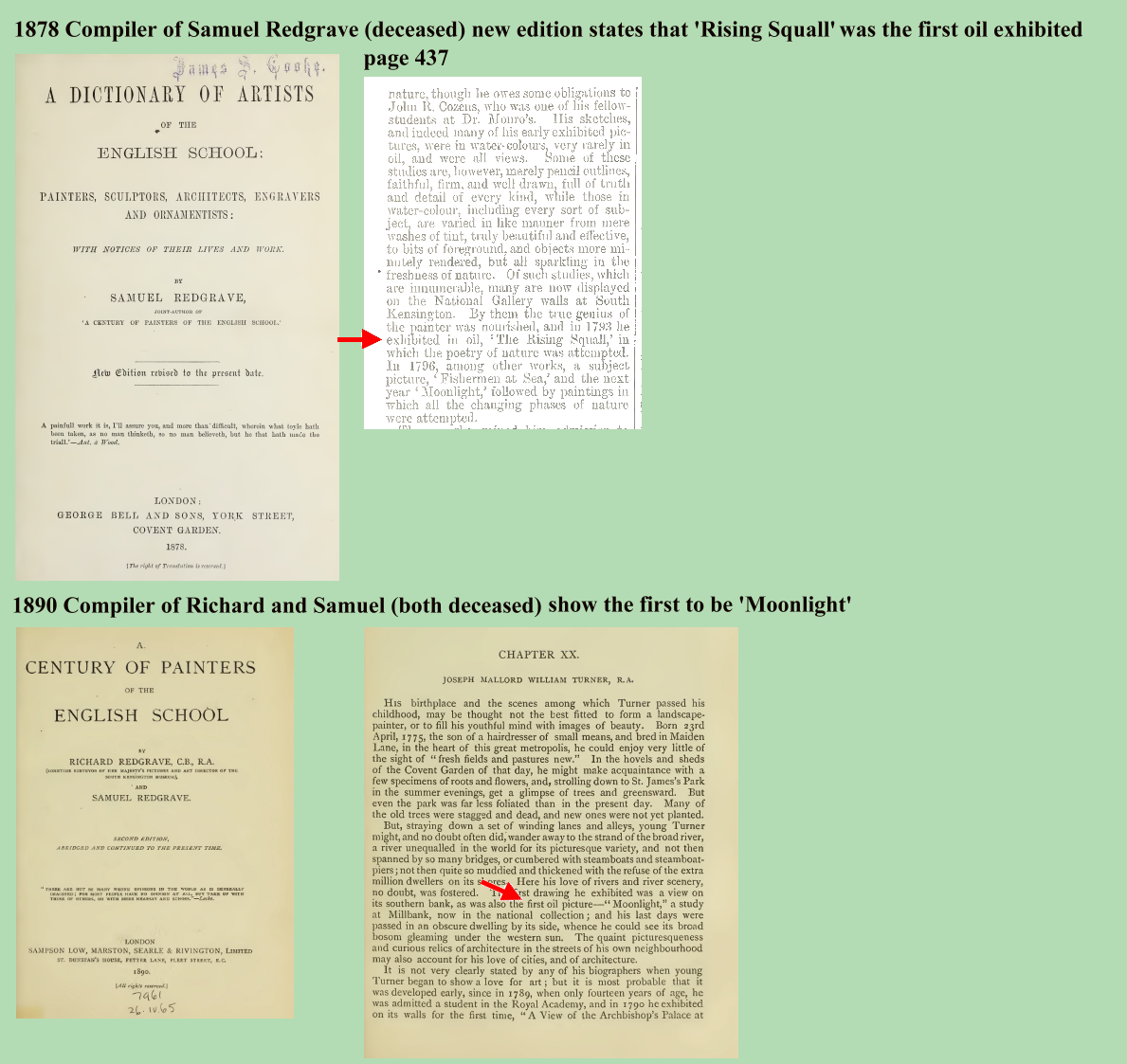
Two years after Samuel's death his 'Dictionary of Artists' was reprinted as a new edition. There were no changes to Samuel Redgrave's statement that the 1793 oil was 'The Rising Squall'. The timing of this publication is significant: in 1878 Richard Redgrave was still alive aged 74 and at this time held a position of 'surveyor of crown pictures' (wikipedia - not illustrated) which would suggest that he was still mentally sound and would have been able to contribute any corrections to his late brother's work if appropriate.
Richard died in 1888 and two years later, in 1890, the 'A Century of Painters of the English School' was reprinted as a 'second edition'
At this time, 1890, there were two 'new' versions of these books but in the reverse order of their original publication dates. 'A Century of Painters of the English School' now looked like the latest publication (1890) and the 'Dictionary of Artists' appeared to be the earlier publication.
@@@@@
In 1901 when CF Bell compiled 'A List of the Works Contributed to Public Exhibitions by JMW Turner RA'
The passage illustrated shows CF Bell describing 'Century of Painters of the English School' as a correction to 'Dictionary of Artists'. He appears to have worked from the second editions because this statement is quite simply not true.
The correct position is that 'Dictionary of Artists' updated or corrected a mistaken view published in 'Century of Painters of the English School'.
Richard's son, Gilbert Redgrave, wrote his 'A History Of Water-Colour Painting in England' in 1905. He wrote positively that "Even at this time he [Turner] was working much in oil. As early as 1793 he exhibited 'The Rising Squall".
Despite Gilbert's work, or perhaps because it's title was concerned with "Water-Colours", CF Bell's erroneous statement has prevailed amongst some modern researches.