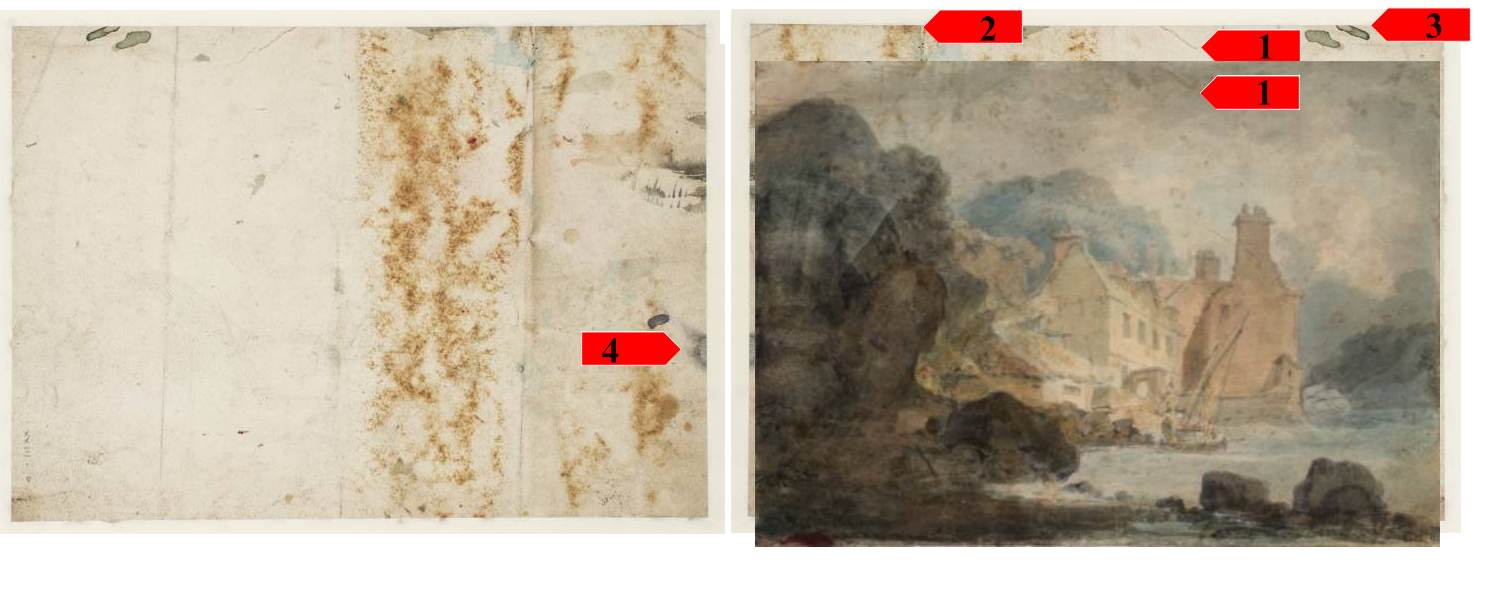
'Back View of the Hot Wells, Bristol', D00389 - Both Sides
This watercolour is close in size to pages in 'The Bristol and Malmesbury Sketchbook' but is probably not the page known to have been removed from it (at Fo.18).
NB - A note on trimming:
We refer to physical trimming but it must be borne in mind that much
of the material produced online by institutions is 'adjusted' to make web
pages 'look nice'. Note below that D40334 has been laid out on a larger
background so that the very edges of the sheet are visible - however this
could be an illusion created by 'cropping' the image digitally. The image
of D00389 is almost certainly cropped but the lack of communication by
Tate curators makes it too expensive to pursue.
Watercolour 'Back View of the Hot Wells, Bristol', D000389, 184x256mm painted after (or possibly during) Turners visit to his father's friends, the Narraways, in Bristol in 1791 appears to have been slightly trimmed. Pages in 'The Bristol and Malmesbury Sketchbook' are 185x263mm and one torn-out page left a stub 10 to 17mm wide which would make the torn-out page less than 253mm wide. The watercolour appears to be slightly too big to be a page from 'The Bristol and Malmesbury Sketchbook'.
On the left is the image of the verso as supplied by Tate D40334. To the right that image has been reversed (horizontally) and the recto D00389 overlaid to show alignment with the verso.
The orientation can be determined by marker 1 a distinctive stain or fold which appears on both sides of the paper.
The images were supplied at different resolutions. Marker 1 can also be used to determine alignment. The recto image was then resized to align the stain at marker 2. Slight misalignment shows that the recto image has been cropped slightly.
The presentation of the verso, laid out on a slightly larger cream coloured background, suggests that the entire sheet, as it now stands, has been photographed. If so the stain at marker 3 is 'impossible'; that is, to produce this stain the paper had to be larger. Other edge stains also appear to be 'cut off'.
It is not unreasonable to suppose that the sheet has been trimmed and looking at the marker 3 stain a minimum of 5mm appears to be a good approximation. It cannot be assumed that it would be trimmed 5mm all round; that figure can be said of only the top of the sheet. Marker 4 shows another stain that has probably been clipped by a few mm.
The stated size of the sheet now is 184 x 256mm.
The stated size of folios in the Bristol and Malmesbury Sketchbook is 185 x 263. The 'narrow stub' at Fo.18 is about 10 to17mm. So the torn out page width is between 246 and 253mm.
Given that D40334/D00389 has probably been trimmed to its current size, whilst being close to the size of the torn out page in the Bristol and Malmesbury Sketchbook, it appears to be slightly too big to be the missing page. It is, however, close to the paper size that Turner had in his sketchbook at the Narraways
D40334/D00389 and the stub are both white wove paper without watermark. Watermarks appear elsewhere in the sketchbook (the watermark on Fo.12 is 'J WHATMAN').