PRESENTATION ~O~
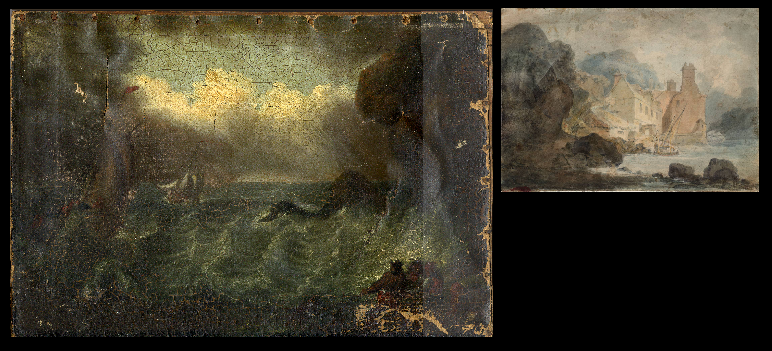
The discovery of JMW Turner's oil on canvas exhibited at the Royal Academy
in 1793 ~O~
PRESENTATION
Study of 'The St. Vincent's Rock Oil'
It is St.Vincent's Rock
'The St. Vincent's Rock Oil' picture is clearly the St. Vincent's Rock, rock-complex as invented by Turner. Turner's picture was referred to by several titles over time but Turner's title was rarely quoted in full, 'The Rising Squall - hot wells from St. Vincent's Rock, Bristol'. 'The St. Vincent's Rock Oil' matches the location as Turner described it - the view is at hot wells, the hot wells buildings are not visible because the observer is looking out into the river at a rising squall. The view is however, 'from' St' Vincent's Rock which is included in the scene close by the viewing point.
It is emhasised that this is the element actually linking 'The St.
Vincent's Rock Oil' with Turner. This evidence is so distinctive, unique
and strong as to show that 'The St. Vincent's Rock Oil' can be only 'The
Rising Squall, Hot Wells, from St. Vincent's Rock, Bristol' by Turner and
nothing else. This rendition of the St. Vincent's Rock, rock-complex has
been found only in Turner's D00389. A similar but not identical rendition
was seen in Turner's 'Dunstanborough Castle' (1798). It is not evident in
the work of any other artist.
Click the picture for a visual presentation.
(9 pages with various comparisons of the St. Vincents Rock,
rock-complex)
There is little, stylistically, to link it to Turner's later oils. This, however, is to be expected: Those who knew Turner's later works and saw Turner's early oils described the early oils as, 'Differing in every quality from the characteristics of his present works.' (B&J Cat. No.538 (Italian Landscape) 1835)
[_NEXT_]
30_15