

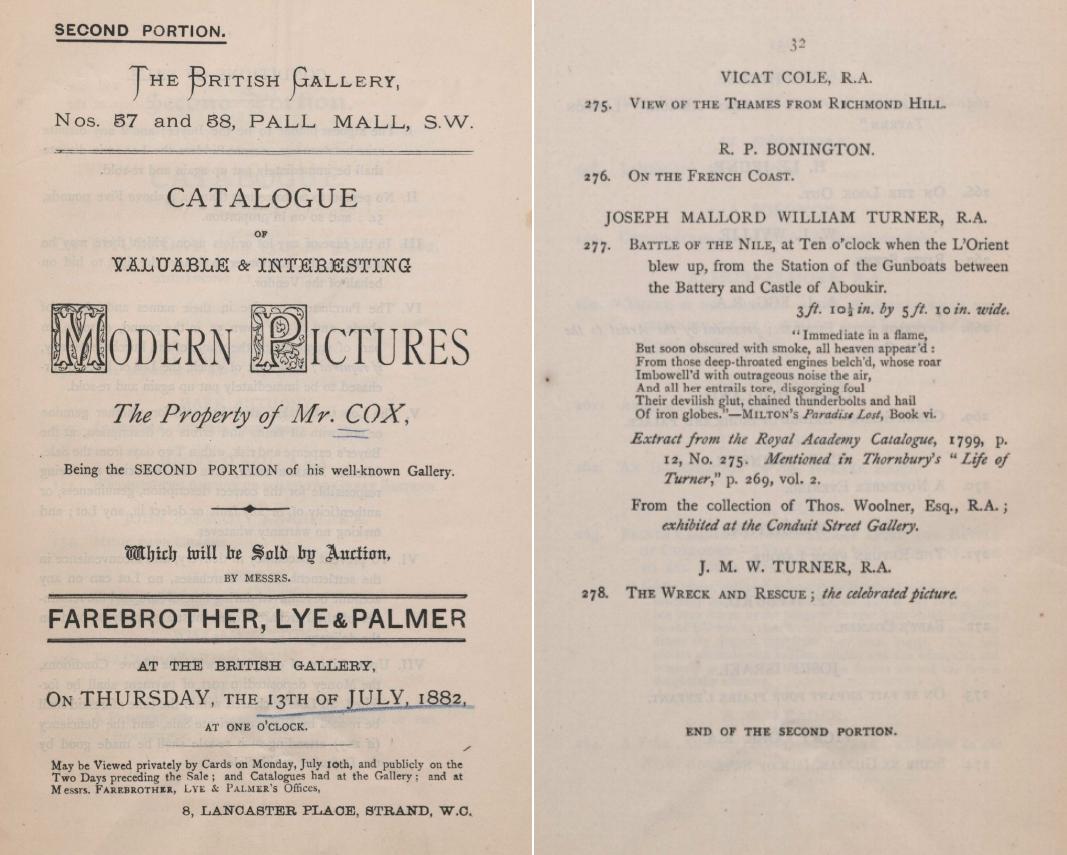
Farebrother, Lye and Palmer Auction Catalogue 13th July 1882 Lot 277 page 32
Primary Source:
Internet Archive from Frick Art Research Library
Catalogue Title Page and Page 32:
|
Farebrother, Lye and Palmer Auction Catalogue 13th July 1882 Lot 277 page 32 Primary Source: Internet Archive from Frick Art Research Library Catalogue Title Page and Page 32:
|
||
|
Transcript of the Title Page: The British Gallery Nos. 57 and 58, Pall Mall, London, S.W. Catalogue of Valuable & Interesting Modern Pictures The Property of Mr. Cox, Being the second portion of his well-known Gallery. Which will be sold by auction by Messrs. Farebrother, Lye & Palmer at the British Gallery on Thursday, the 13th of July, 1882, at one o'clock. May be viewed privately by Cards on Monday, July 10th, and publicly on the two days preceding the sale; and Catalogues had at the Gallery; and at Messrs. Farebrother, Lye & Palmer's Offices, 8, Lancaster Place, Strand, W.C. Transcript of Lot 277: JOSEPH MALLORD WILLIAM TURNER, R.A. 277. BATTLE OF THE NILE, at Ten o'clock when the L'Orient blew up,
from the Station of the Gunboats between the Battery and Castle of
Aboukir.
[A passage from Milton's 'Paradise Lost'] Extract from the Royal Academy Catalogue, 1799, p. 12, No. 275, Mentioned in Thornbury's "Life of Turner," p. 269, vol.2. From the collection of Thos. Woolner, Esq., R.A.; exhibited at the Conduit Street Gallery. |
||
|
Commentary: This is a sale of 'Modern Pictures'; that is, oil paintings. There are three inferences which can be relied upon in this catalogue:
Thomas Woolner’s personal art collection was sold at Christie's on May 21st 1895. The sale of this 'Battle of the Nile' to Mr. Cox was therefore a lifetime sale sometime before July 1882. The Farebrother catalogue does not provide a date in respect of the claim that the painting was exhibited at the Conduit Street Gallery. Associated Words and Phrases:
|
||